Best 12V Air Conditioner for RVs: Off-Grid Cooling Solutions
Discover reliable 12V rooftop air conditioners designed for RVs, vans, campers, and trailers. This guide highlights five top models that deliver off-grid cooling, quiet operation, and durable construction for mobile living. Each choice focuses on energy efficiency, easy installation, and compatibility with battery power or solar setups to help travelers stay comfortable without idling engines.
| Product | Brand | BTU | Key Feature |
|---|---|---|---|
| RV Air Conditioner, 12V 10000 BTU Rooftop | outequip | 10000 | Includes heater option for mild warmth |
| OutEquipPro 12V 10000 BTU Rooftop AC | outequip | 10000 | Battery-powered for off-grid use |
| 12V Air Conditioner 12000BTU (Teousev) | Teousev | 12000 | Low-noise, eco-friendly operation |
| Countrymod 12V DC RV 10000 BTU | countrymod | 10000 | Inverter design; energy-saver |
| Treeligo 12V RV Air Conditioner Ultra-Quiet | Treeligo | 7900 | Heating & cooling in one unit |
RV Air Conditioner 12V 10000 BTU With Heater

This unit delivers 10,000 BTU of cooling to rapidly lower interior temperatures, with an integrated 4,500 BTU heater for mild-warm conditions. It is designed for off-grid readiness, running on your vehicle battery, and features UV-stabilized materials and durable gasketing for weather resistance. The heater is suitable for light warmth but not a primary heat source in very cold conditions or large spaces.
OutEquipPro 12V 10000 BTU Rooftop AC
The OutEquipPro model cools efficiently in about 15 minutes with 10,000 BTU capacity. It’s engineered for off-grid use by drawing power from the vehicle battery, offering extended runtime (approximately 8–10 hours depending on battery capacity). It shares the same durable, weather-resistant construction as the heater-enabled version, including UV-stabilized ABS materials and a zinc-coated condenser for rugged environments.
12V Air Conditioner 12000BTU (Teousev)

Teousev’s 12,000 BTU unit is powered directly from a 12V battery, enabling operation without engine idling. It emphasizes energy savings with a 960W rating and a quiet performance (approximately 40 dB). The design targets broad vehicle compatibility, including vans, trucks, trailers, and other RV configurations, with five 360° vents for even cooling distribution.
Countrymod 12V DC RV 10000 BTU Non-Ducted

Countrymod offers a 10,000 BTU inverter-design air conditioner for 12V systems, emphasizing rapid cooling with on-demand capacity and cost-conscious operation. Claimed energy efficiency targets around 0.3 kWh per hour, extending battery life up to about 10 hours. It features ultra-low noise levels (45–55 dB) and distributes cold air evenly to minimize direct blasts.
Treeligo 12V RV Air Conditioner Ultra-Quiet
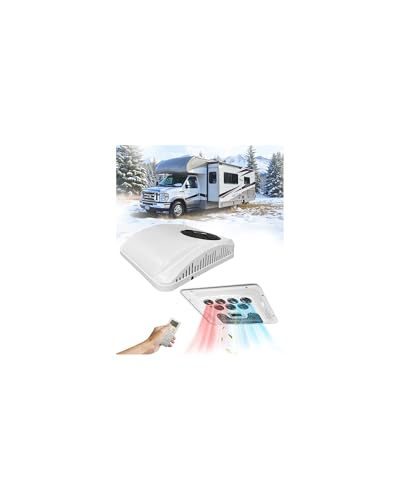
Treeligo’s unit combines heating and cooling with a compact, roof-mounted design suitable for standard RV skylights. It operates via a 12V DC scroll compressor, reducing reliance on engine idling and encouraging off-grid use. The setup is described as easy to install on compatible roof dimensions, with a focus on quiet operation and efficient energy use for travel trailers and campers.
Countrymod 11,000 BTU 12V DC RV AC

This version provides 11,000 BTU with a similar inverter design and energy-saving profile. It targets drivers seeking higher cooling capacity in a 12V setup, maintaining low noise operation and battery-friendly performance for diverse RV configurations, trailers, and food trucks. The unit aims to balance cooling power with efficient power use for extended off-grid stays.
Rooftop Air Conditioner For RVs Buying Guide
- Power compatibility: Confirm 12V DC compatibility with your battery bank and charging setup (solar, alternator, or shore power) and verify amperage requirements for safe operation.
- Cooling capacity vs. space: Match BTU to your RV size. Larger rigs benefit from higher BTU, but larger units draw more power; ensure your system can sustain it.
- Energy efficiency: Look for inverter or variable-frequency designs that adjust compressor speed and reduce power draw, increasing runtime on battery power.
- Heat options: Some units include built-in heat pumps or auxiliary heaters. Assess whether you need heating and whether the unit’s heater is suitable as a primary heat source in winter.
- Noise level: Quieter models (often below 50 dB) are preferable for nighttime comfort. Check ground-level and cabin acoustics for guest and driver comfort.
- Weight and installation: Roof-mounted units require proper roof support, sealant, and space. Ensure the chosen model fits your roof cutout and there is adequate clearance for vents and ducts, if applicable.
- Durability and weather resistance: Look for UV-stabilized housings, corrosion-resistant condensers, and gasket materials designed for outdoor exposure and travel conditions.
- Maintenance and service: Consider availability of replacement parts, filters, and service support in your travel regions.
- Budget and lifecycle: Higher BTU and features add upfront cost but may save fuel or battery life in the long run; evaluate total cost of ownership alongside expected usage.