If you’re shopping for the most efficient gas furnaces, you want models that deliver strong AFUE ratings, reliable performance, and practical installation options. This guide highlights five top options, explains who they’re best for, and notes any limitations. It’s ideal for homeowners seeking energy savings, quieter operation, or multi‑stage heat control. The buyer’s table below summarizes key details to compare at a glance.
| Product | BTU | AFUE / Efficiency | Installation Type | Best For |
|---|---|---|---|---|
| Goodman 92% AFUE Single Stage GR9S920803BN | 80,000 | 92% | Upflow/Horizontal, 17.5″ width | Budget‑friendly efficiency for mid‑range homes |
| Goodman 120,000 BTU 96% GR9T961205DN | 120,000 | 96% | Upflow/Horizontal, 24.5″ width | Homes needing higher heating capacity |
| Goodman 96% AFUE Two Stage GR9T960603BN | 60,000 | 96% | Upflow/Horizontal, 17.5″ width | Quiet, efficient heat with two‑stage control |
| Goodman 100,000 BTU 80% GR9S801005CN | 100,000 | 80% | Upflow/Horizontal, 21″ width | Budget‑conscious with solid performance |
| Goodman 80,000 BTU GR9S800804BN | 80,000 | 80% | Upflow/Horizontal, 17.5″ width | Compact, economical option for smaller spaces |
Goodman 92% AFUE Single Stage GR9S920803BN

The Goodman GR9S920803BN is a single‑stage furnace offering 92% AFUE for reliable efficiency. It uses a multi‑speed setup and upflow/horizontal installation with an 80,000 BTU capacity. The model is better for mid‑size homes with moderate heating needs. The listed features include a 10‑year parts limited warranty when installed by a qualified installer and registered online within 60 days, enhancing long‑term reliability. A potential limitation is that single‑stage operation may be less efficient in variable outdoor temperatures compared with multi‑stage options.
Goodman 120,000 BTU 96% GR9T961205DN

This model delivers 96% AFUE with a multi‑speed ECM motor and two‑stage operation, supporting higher heating output at 120,000 BTU. It’s suitable for larger homes or spaces needing robust warmth while maintaining efficient airflow and lower noise. It replaces older models and lists installation guidance to ensure proper setup. Best for households seeking stronger performance without sacrificing efficiency. Note that installation considerations and model number alignment (GD9 designations) may apply for certain configurations.
Goodman 96% AFUE Two Stage GR9T960603BN
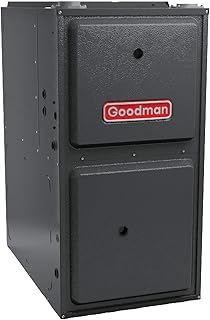
This 60,000 BTU furnace features a dual‑stage heat output with a 96% AFUE rating. The multi‑speed ECM motor aids precise airflow control, improving comfort and reducing operating noise. It’s a strong pick for homes where climate control matters and space is limited by a 17.5″ cabinet width. Best for steady comfort with lower energy costs over time. A caution is that 60,000 BTU capacity may be insufficient for very large homes in extreme cold without supplemental heating.
Goodman 100,000 BTU 80% GR9S801005CN

This model offers 100,000 BTU at 80% efficiency and uses a multi‑speed, upflow/horizontal configuration. It includes a 60‑day registration requirement for a 10‑year parts limited warranty and emphasizes durable stainless steel tubular primary heat exchanger. It’s best for budgets where initial cost matters while still delivering reliable heat. Limitations include an 80% efficiency rating, which is lower than mid‑ to high‑efficiency options in this guide.
Goodman 80,000 BTU GR9S800804BN

The GR9S800804BN furnishes 80,000 BTU at 80% AFUE with a multi‑speed ECM motor for improved airflow and noise reduction. It is a compact option with a 17.5″ cabinet width, making it suitable for smaller spaces or retrofit installations. Best for cost‑conscious buyers who still want dependable heating efficiency. A potential limitation is the 80% efficiency level compared with higher AFUE models, which could influence long‑term energy costs in very cold climates.
Buying Guide: Key Factors for Choosing Efficient Gas Furnaces
- Efficiency rating (AFUE): Higher AFUE means less energy wasted. In moderate climates, 90%+ units often balance cost and savings; in very cold climates, 96% models may deliver better annual savings.
- Stage and modulation: Single‑stage furnaces are simple and cheaper, while two‑stage or modulating models provide more even temperatures and lower noise during operation.
- Capacities and space: Match BTU and cabinet width to your home size and installation space. Compact models fit tighter spaces but ensure heat output matches demand.
- Motor type: ECM multi‑speed motors improve efficiency and airflow control, reducing energy use and operating noise.
- Warranty and installation: Look for warranties that require proper installation and online registration. This protects the investment and ensures compliance with performance expectations.
- Compatibility and configuration: Confirm upflow vs downflow orientation and ductwork compatibility. Some models require specific configurations or regional restrictions.
Frequently Asked Questions
- What is AFUE and why does it matter? AFUE expresses furnace efficiency as a percentage of fuel converted to heat. Higher AFUE means less wasted energy and lower operating costs over time.
- Should I choose a two‑stage furnace if available? Yes, two‑stage or multi‑stage units tend to deliver more even heating and quieter operation, especially in fluctuating outdoor temperatures.
- Is a larger BTU always better? Not necessarily. Choose BTU based on your home size, insulation, and climate. Oversized furnaces heat quickly but can lead to humidity and cycling issues.
- Do all these models support ECM motors? Many do, particularly multi‑speed ECM variants, which improve efficiency. Verify motor type in the product specs.
- Are installation requirements important for warranty? Yes. Many warranties require professional installation and online registration to remain valid.
- Can I mix and match brands with existing systems? It’s best to maintain compatibility with ductwork, control boards, and refrigerant/air handling connections, or consult a licensed technician.