Smart humidity switches for fans automate bathroom ventilation and moisture control, helping maintain comfortable room conditions and protect against mold. This guide highlights five top options, covering neutral-wire requirements, installation fit, and adjustable humidity levels. Each entry includes practical features to match common bathroom layouts and retrofit projects.
| Product | Brand | Key Features |
|---|---|---|
| Leviton DHS05-1LW | Leviton | Automatic fan control, slim wallbox profile, compatible with or without neutral wire |
| TOPGREENER TDHS5-N | TOPGREENER | Humidity sensing, three sensitivity levels, auto on/off, neutral required |
| TOPGREENER TDHS5 | TOPGREENER | Two-pack with wall plate, auto humidity control, flexible installation |
| Ortis New Generation Humidity Sensor Switch | Ortis | Minimum run-time setting, dehumidification function, auto/manual modes, 120V/220V |
| LIDER No Neutral Humidity Sensor Switch | LIDER | No neutral required, adjustable timing, sleek design, wall plate included |
The following sections present five selected options. Each product is described with its main strengths and how it fits typical bathroom ventilation needs.
Leviton DHS05-1LW Humidity Sensor Switch

The Leviton DHS05-1LW provides automatic on/off control for bathroom exhaust fans, helping to manage moisture without manual operation. Its slim profile fits most wall boxes, simplifying retrofits. The device is flexible enough to be installed with or without a neutral wire, catering to older wiring and newer homes alike. This option is suitable for standard ¼ HP fans and is designed to support reliable moisture management in typical bathroom layouts.
TOPGREENER TDHS5-N Humidity Sensor Switch

This TOPGREENER model detects excess humidity and automatically activates the ventilation fan, ideal for highly moist spaces like bathrooms, laundry rooms, and basements. It offers three humidity levels (low, medium, high) to tailor ventilation to the room’s needs. After humidity returns to normal, the fan turns off, reducing energy use. A manual bypass option lets users turn the fan off temporarily if desired. Neutral wire is required for installation.
TOPGREENER TDHS5 2-Pack Humidity Sensor Switch

This two-pack from TOPGREENER provides consistent humidity-sensing control across multiple rooms or shared spaces. Each unit automatically turns on the ventilation fan when humidity rises above the preset level and turns off when humidity normalizes. Three sensitivity levels match varied bathroom sizes and venting needs. It requires a neutral wire for installation and includes flexibility to bypass the sensor manually when needed.
Ortis New Generation Humidity Sensor Switch
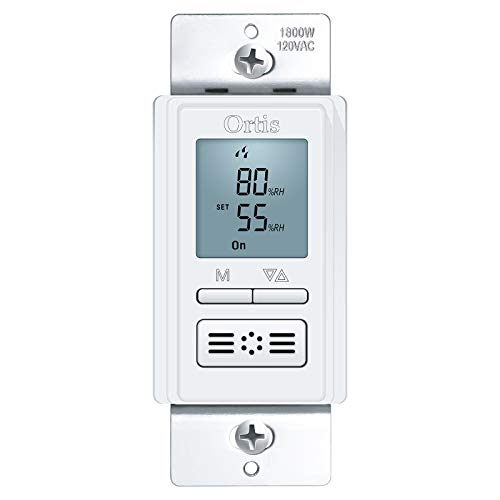
The Ortis New Generation humidity sensor switch introduces an updated operation for minimum run time and a robust dehumidification function. It supports Auto/Manual modes with a default auto time range from 1 to 60 minutes, enabling precise control over fan duration. The device is versatile, supporting 120V and 220V installations, and can pair humidity sensing with additional humidification options for dry environments. It emphasizes flexible control for both quick venting and prolonged moisture management.
LIDER No Neutral Wire Humidity Sensor Switch

The LIDER humidity sensor switch is designed for homes without a neutral wire, featuring adjustable timing and a clean, modern look. A wall plate is included for a cohesive install, and the unit supports typical fan loads while offering user-friendly humidity sensitivity controls. This option is well-suited for older homes or retrofit projects where neutral wiring is unavailable or costly to add.
Buying Guide
Key considerations when choosing a humidity sensor switch for a fan include compatibility, wiring, and control behavior. Here are factors to compare across options:
- Wiring requirements: Neutral wire needed vs. no-neutral models. Neutral-enabled units often offer broader compatibility with modern circuits, while no-neutral options simplify retrofit in older homes.
- Humidity sensitivity: Look for devices with 2–3 sensitivity levels or adjustable presets to fit the bathroom size and humidity profile.
- Auto vs. manual modes: Auto mode activates based on humidity; manual mode allows immediate fan control. Some models also offer a timer to extend run time after activation.
- Electrical load: Verify fan compatibility by horsepower or wattage (e.g., 1/4 HP is common). Some products are rated for LED/CFL and incandescent loads as well.
- Installation considerations: Slim wall-box compatibility, wall-plate options, and whether the device requires a neutral or ground connection.
- Durability and certifications: UL-listed products offer reliable safety and performance in moisture-prone spaces.
- Multi-room setups: If pairing devices across bathrooms, consider a two-pack option and whether wall-plates are included for a unified look.
- Define your bathroom’s typical humidity levels and choose a model with an appropriate sensitivity range.
- Determine wiring feasibility: if your home lacks a neutral wire, prioritize no-neutral options or plan for install changes.
- Decide between auto-only or hybrid auto/manual functions, depending on whether you value hands-off control or occasional direct ventilation.
- Assess load requirements for the fan and any connected lighting to ensure safe, compatible operation.
- Consider aesthetics: wall plate designs and color-matching options help maintain a cohesive bathroom appearance.