Choosing the right air conditioner for an enclosed trailer or camper involves balancing efficiency, power requirements, and climate control across seasons. This guide highlights five popular RV AC units that pair well with enclosed trailers, including heat pump options for year-round comfort. Each product is evaluated for energy use, durability, noise levels, and ease of install to help you compare without the guesswork.
| Product | BTU/Heating | Key Benefit | Brand |
|---|---|---|---|
| RecPro RV Air Conditioner 15K Ducted | 15,000 BTU cooling | Low amp draw, quiet operation | RecPro |
| outequip RV Air Conditioner 10,000 BTU | 10,000 BTU cooling | 12V operation with heater, compact | outequip |
| TOSOT 16,000 BTU GO Cool | 16,000 BTU cooling / 12,500 BTU heating | WiFi control, wide temperature range | TOSOT |
| TURBRO 15,000 BTU | 15,000 BTU cooling / 1,500W heating | Quiet operation, WiFi remote control | TURBRO |
| FOGATTI InstaCool 13,500 BTU | 13,500 BTU cooling | All-in-one design, eco-friendly refrigerant | FOGATTI |
Note: The products listed here are suitable for RVs and enclosed trailers but always verify fitment for your specific trailer model, electrical setup, and whether ducting is required for non-ducted installations. This overview focuses on energy efficiency, noise, and ease of installation to help you compare options quickly.
RecPro 15K Ducted RV Air Conditioner

Features from the listing emphasize low amp draw for energy efficiency, which supports off-grid setups with solar or generators by reducing peak electrical demand. The unit showcases a durable road-ready construction with UV-resistant plastic designed to resist weathering and fit most RVs, campers, and fifth wheels. Additionally, the model operates at a whisper-quiet 55.4 dB, enabling peaceful sleep, work, or relaxation without the typical hum common to rooftop RV units. This RecPro option is suitable for campers who need a ducted or non-ducted installation path and prioritize quiet operation alongside robust durability.
outequip 12V 10,000 BTU RV Rooftop AC

This compact unit offers 10,000 BTU of cooling with an integrated 4,500 BTU PTC heater, ideal for mild shoulder seasons or smaller trailers. It provides quick cooling in as little as 15 minutes and uses UV-stabilized ABS materials, an EPDM foam gasket, and a zinc-coated condenser for weather resistance. While the heater is supplementary and not intended as a primary heat source in extreme cold, this setup is well-suited for travelers needing reliable cooling with basic heating capabilities in a lightweight, rugged package.
TOSOT 16,000 BTU GO Cool RV AC

This non-ducted unit combines strong cooling with a robust 12,500 BTU heating capacity, making it suitable for RVs up to 600 square feet. It features smart WiFi control via the Gree+ app, enabling remote temperature management. The Go Cool series is designed to handle outdoor temperatures ranging from 23°F to 115°F, with an indoor cozy range of 61°F to 86°F, ensuring versatile performance across seasons for mid-to-large RVs and enclosed trailers. The product emphasizes flexible operation and reliable performance in varying climates.
TOSOT 16,000 BTU GO Cool (Black) RV AC

Black variant of the same Go Cool line offers the same 16,000 BTU cooling and 12,500 BTU heating, with WiFi connectivity and remote operation. It maintains outdoor operation tolerance from 23°F to 115°F and indoor comfort from 61°F to 86°F. This model provides a stylish option for RVs seeking a darker exterior finish while delivering the same multi-season climate control and convenience through smartphone app control.
FOGATTI InstaCool 13,500 BTU RV AC
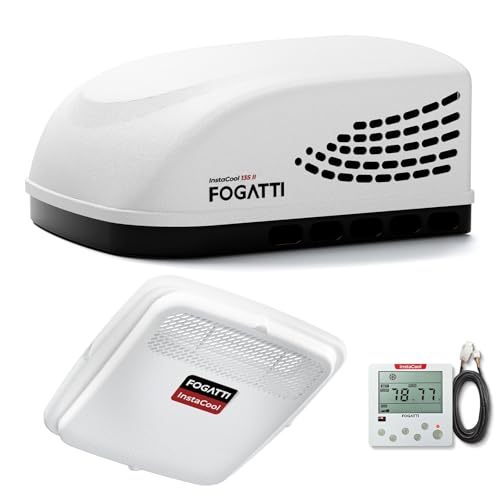
FOGATTI InstaCool emphasizes an all-in-one design with dual high-efficiency compressors and 13,500 BTU of cooling capacity for quick cooling. The unit uses eco-friendly R32 refrigerant and focuses on smart energy savings through advanced fan control and temperature regulation. It requires connection to both 115V AC power and 12V DC power, reflecting a typical RV rooftop installation that combines both power sources. This option suits campers and trailers where rapid cooling and efficient energy use are priorities.
Buying Guide: Key Purchase Considerations
- Power availability and electrical system compatibility: Ensure your trailer’s electrical system (120V AC and 12V DC if needed) can handle the unit’s requirements, especially when running multiple appliances.
- BTU rating and trailer size: Match cooling capacity to your trailer length and floor plan. Too large a unit can waste energy; too small can struggle in hot climates.
- Heating capability: If year-round comfort is important, consider units with heat pump capability or integrated heating to cover shoulder seasons efficiently.
- Noise levels: For on-the-road use, quieter models (around 50–60 dB) can significantly improve comfort inside the trailer during sleep or meals.
- Installation type: Ducted vs. non-ducted options affect how you route airflow within the trailer. Ducted setups may require additional installation work but distribute air more evenly.
- Durability and weather resistance: Look for UV-stable housing, corrosion resistance, and gasket quality to withstand outdoor exposure at campsites.
- Smart features and app control: WiFi or app-enabled units provide convenient remote adjustments, especially for trailers parked away from the main living area.
- Energy efficiency: Models with low amp draw or inverter technology can extend off-grid usability when paired with solar or generators.
- Maintenance and service support: Choose brands with accessible replacement parts and dealer networks to simplify repairs and upkeep.
Across these options, readers should weigh whether they prioritize ultra-quiet operation, year-round heating, smart control, or installation flexibility for a given trailer. For off-grid campers, a low amp draw combined with a reliable heat pump can maximize comfort without overtaxing a solar setup. Those in more temperate climates might prioritize a high BTU rating and efficient cooling with smart app management for convenience. Durability remains essential for rooftop units exposed to the elements, while ease of installation can save time and prevent leaks. Each product in this guide provides a distinct balance of these factors to help you decide which unit best fits your enclosed trailer or camper.