Growing plants indoors requires reliable climate control. The right air conditioning unit helps maintain stable temperatures and humidity, supporting vigorous growth and preventing heat stress. This guide highlights five top portable and windowless cooling options that are well-suited for grow rooms, including quiet operation, energy efficiency, and user-friendly controls. Explore models from Dreo, Wiytamo, COOLECH, and ZAFRO to find a unit that fits your space, humidity needs, and budget.
| Product | Brand | BTU / Type | Notable Feature |
|---|---|---|---|
| Dreo AC515S | Dreo | 12,000 BTU ASHRAE | Low noise, 3-in-1 mode (cool, dehumidify, fan) |
| Wiytamo 10,000 BTU | Wiytamo | 10,000 BTU | 3-in-1 cooling, smart app control |
| COOLECH 4-IN-1 Windowless | COOLECH | 4-mode evaporative cooler | Waterless alert, 12H timer |
| ZAFRO 10000 BTU | ZAFRO | 10,000 BTU (SACC 6000 BTU) | APP control, quiet operation, drainage-free |
| COOLECH Windowless 42 Inch | COOLECH | 42 Inch evaporative cooler | 90° oscillation, 1400 CFM, multi-mode |
Note: The options above balance cooling power, noise level, and ease of use. Evaporative (swamp) coolers are particularly appealing in dry climates, while traditional portable AC units excel in humidity-controlled environments. Each model offers features that can support grow room conditions, from precise temperature ranges to remote management.
Dreo AC515S Portable AC for Rooms

The Dreo AC515S delivers a robust 12,000 BTU ASHRAE cooling capacity, suitable for mid-to-large grow spaces up to around 16 feet in cooling reach. It supports a temperature range from 65°F to 86°F and combines cooling with dehumidification and fan functions in a single 3-in-1 unit. A distinctive feature is its noise isolation around the compressor, which helps reduce operating sound to approximately 46dB—beneficial for maintaining a stable, low-stress environment for plants and personnel. The compact form and multiple control options (APP, voice, remote) make it a practical choice for climate-sensitive grow rooms where quiet operation matters.
Dreo 12,000 BTU Smart AC, New Model

This newer Dreo unit preserves the core 12,000 BTU capacity while emphasizing a patented noise isolation system that lowers audible noise to about 45dB. It includes a drainage-free self-evaporating feature that can minimize water handling in humid grow rooms, especially when humidity fluctuations are frequent. The model’s connectivity (APP/remote/voice) supports monitoring and scheduling, enabling precise temperature control during different growth cycles without requiring manual adjustments at every session. The extended range and quiet operation make it a reliable option for rooms with sensitive plant varieties.
Wiytamo 10,000 BTU Portable AC
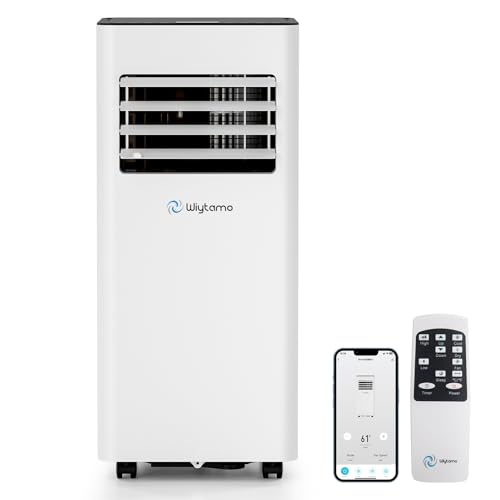
The 10,000 BTU model from Wiytamo targets rooms up to 450 sq.ft. It functions as a 3-in-1 unit (cooling, dehumidifying, fan) with a self-contained drainage or self-evaporation option depending on humidity. A built-in smart sensor helps optimize compressor usage for efficiency, while the app and remote provide flexible control. This unit is suitable for grow spaces that require reliable cooling with energy-efficient operation and remote management to align with light cycles and irrigation schedules.
COOLECH Windowless 4-Mode Evaporative Cooler
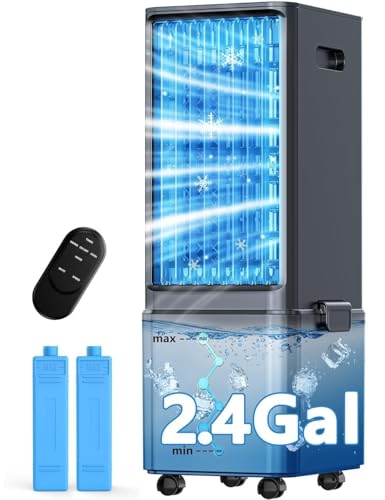
COOLECH’s 4-in-1 evaporative cooler offers cooling, normal, sleep, and nature modes with three wind speeds. It is designed for dry environments, delivering moisturized air that can help counteract dryness in grow rooms without heavy condensate. The waterless alert system guards against dry-operation risks and ensures continuous performance. While not a traditional compressor-based AC, this unit excels in specific agricultural settings that benefit from humidity management and low-energy operation. It is portable, and its 90° oscillation supports even air distribution across grow tents or small rooms.
COOLECH 42 Inch Windowless Portable AC
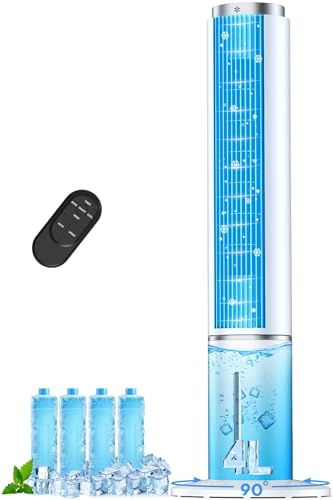
This 42-inch evaporative cooler from COOLECH combines powerful airflow (up to 1400 CFM) with a wide 90° oscillation to create an even cooling pattern across larger grow spaces. It provides four modes and three speeds, enabling a broad range of climate settings from dry, cool airflow to more humidified airflow. The large duct-outlet design suits medium-sized grow rooms where uniform air movement is crucial for consistent canopy environment. The No Window Needed feature makes it versatile for converted closets, garages, or dedicated grow rooms without external venting requirements.
Buying Guide: Key Purchase Considerations For Grow Rooms
- Cooling capacity vs. space: Match BTU or CFM to room size and plant canopy. Undersized units struggle during peak heat, while oversized units may cause humidity swings.
- Humidification and dehumidification: Growing environments often need precise humidity. 3-in-1 units (cooling, dehumidifying, fan) give flexibility; evaporative coolers can add humidity in dry climates but may not suffice in humid spaces.
- Noise and vibration: Quiet operation reduces stress on plants and keeps personnel productive. Look for models with noise-optimized compressors or insulation technology.
- Energy efficiency: Energy-efficient modes and smart controls can align cooling with grow-light cycles, reducing electricity use and heat load in tents or rooms.
- Drainage and maintenance: drainage-free/self-evaporating designs simplify setup in spaces without drainage. Water alerts and timers help maintain safe operation.
- Mobility and installation: Portable units with caster wheels and handles enable repositioning as plant layouts evolve. Windowless options suit rooms with limited ventilation options.
- Control options: Apps, remotes, and voice control enable scheduling and remote adjustments, which is helpful when managing multiple grow zones.
- Climate safety: Consider units with auto shutoff or alert features if temperatures exceed targets, protecting delicate crops during heat waves.
When selecting a unit for grow rooms, evaluate the crop type, light intensity, and cycling schedule. For humidity-sensitive crops, consider dehumidification capabilities and soil moisture interaction. For drier climates, evaporative coolers paired with humidity management can offer efficient cooling with lower energy use. In humid environments, compressor-based air conditioners with dehumidification are often more effective at stabilizing air without adding excess moisture.