Best Air Eliminators for Boilers: Top 5 for Efficient Hydronic Heating
Air in hydronic systems can impede performance, reduce efficiency, and cause hot water radiators to heat unevenly. This article highlights five reliable air eliminators ideal for boilers and radiant heating setups. Each product is designed to remove trapped air, improve circulation, and extend system life. Read on to compare features, compatibility, and installation considerations to choose the best fit for your boiler.
| Product | Brand | Key Benefit |
|---|---|---|
| Taco 400-4 1/8-Inch-NPT Float Air Hy-Vent | Taco | Sturdy brass, easy cleaning, compatible with hot water radiators and baseboards |
| Valemo VFV-12 Automatic Air Bleed Vent | Valemo | Automatic air vent with 1/8″ NPT, simple automatic purge |
| HYDRO MASTER Automatic Air Vent Valve 1/8 Inch Brass | HYDRO MASTER | Durable brass, universal fit, high temp tolerance |
| Honeywell PV100 Powervent Gold Air Eliminator, 1 In Npt | Honeywell | Power vent design for reliable air elimination |
| Midline Valve SBW-TQ001U Spiral Air Eliminator | Midline Valve | Spiral venting to purge microbubbles, easy inline installation |
Taco 400-4 1/8-Inch-NPT Float Air Hy-Vent

The Taco 400 HY-Vent is a brass, 1/8-inch NPT float air eliminator designed for hot water radiators, baseboards, convectors, radiant panels, and small unit heaters. It handles up to 150 psi and can be opened and cleaned for long-term reliability. Its robust construction suits boiler-based hydronic systems that require consistent air removal without frequent maintenance. The top threading allows service access without disassembly, helping maintain steady system flow and temperature distribution across heating zones.
Valemo VFV-12 Automatic Air Bleed Vent

The Valemo VFV-12 is an automatic air bleed vent with 1/8″ NPT threading and a 150 PSI rating. It provides automatic purging to minimize trapped air, making it a low-maintenance choice for many boiler-based heating systems. Its compact form factor fits alongside boilers and piping while contributing to improved circulation, reduced noise, and more even heat distribution in the radiators or convectors connected to the system.
HYDRO MASTER Automatic Air Vent Valve 1/8 Inch Brass
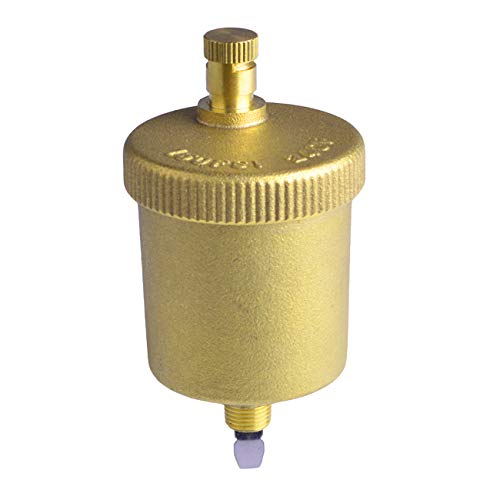
The HYDRO MASTER air vent uses a universal 1/8″ auto air valve design with heavy-duty brass construction. It’s built for endurance in typical heating systems and can withstand up to 150 psi and temperatures up to 240°F. This makes it suitable for many residential boilers and radiant heating setups, where steady air removal is essential for efficient heat transfer and consistent radiator performance.
Gorton #1 3/4″ Steam Air Vent

The Gorton #1 is designed for steam air venting, appropriate for systems where steam risers require venting to prevent condensate and air blockages. While it’s labeled for steam, it remains a robust option in certain boiler configurations where steam or mixed heat phases are present. It supports straightforward vertical installation and helps purge air from risers, contributing to more reliable steam-heated radiators and zones.
Beduan Brass 10500-VE Automatic Float Valve

The Beduan 10500-VE is a brass float valve rated up to 150 psi and 240°F, designed to remove excess air during exhaust and HVAC operation. Its high-temperature resistance and rust protection contribute to durable performance in boiler systems where air release and avoidant pressure build-up are critical for steady operation and prevention of cavitation in pumps and circulators.
Note: The five selections above emphasize reliable air elimination, compatibility with typical residential boilers and hydronic networks, and robust construction for long-term use. When selecting an eliminator, consider system pressure, temperature, connection size, and installation space to ensure optimal operation and minimal maintenance.
Buying Guide: Key Purchase Considerations And Comparisons
- System compatibility: Check the NPT size (commonly 1/8″ or 1/4″) and ensure the vent threads match your boiler piping. Some boilers use larger risers or specialty fittings.
- Material and durability: Brass bodies are common for reliability in hot water systems. Look for corrosion resistance and a sealed, leak-free design to prevent future maintenance.
- Pressure and temperature ratings: Choose vents rated for at least 150 psi and temperatures up to 240°F or higher if your system runs hotter or under higher pressure.
- Automatic vs. manual: Automatic air vents provide hands-off operation, reducing maintenance. Manual vents may be suitable for systems where precise control is required or for initial purge during commissioning.
- Installation layout: Inline, riser, or side-mounted placements affect ease of access for future servicing. Consider space around the boiler and nearby valves or pumps.
- Maintenance needs: Some models are designed to be opened for cleaning and servicing. Factor in whether you prefer easy access for periodic maintenance or a sealed unit.
- Noise and vibration: Effective air elimination reduces gurgling and pump cavitation, leading to quieter operation. Look for designs that minimize turbulence and restrict microbubbles.
- Compatibility with radiant systems: For baseboard or radiant panel heating, ensure the vent can handle the expected flow and pressure in heating circuits.
- Warranty and support: A longer warranty often indicates confidence in durability. Check vendor support and replacement part availability.