Best Air Filtration Systems for Homes: Top Picks for Clean Indoor Air
Air filtration systems help reduce dust, smoke, odors, pet dander, and other pollutants in living spaces. This guide highlights five AHAM VERIFIDE-certified models with strong CADR ratings and washable or replaceable filters, designed for rooms ranging from bedrooms to large living areas. Each entry includes key features to help readers compare performance, efficiency, and maintenance needs.
| Product | Brand | Recommended Room Size | Notable Feature |
|---|---|---|---|
| Core300-P | LEVOIT | Up to 1,073 ft² | AHAM VERIFIDE, 3-in-1 filter with HEPA |
| Vital 200S-P | LEVOIT | Up to 1,875 ft² | Air quality monitor, large-room coverage |
| PR1 | MOOKA | Up to 2,200 ft² | Pet mode, washable pre-filter |
| HAP607 | FreAire | Up to 2,600 ft² | Real-time PM2.5 display, large-room purification |
| PuroAir 240 | PuroAir | Up to 1,000 ft² | 3-layer filtration, high-efficiency removal |
LEVOIT Core300-P: Compact Power For Medium Rooms

Designed for versatile home use, the Core300-P delivers strong performance in a compact footprint. It features a 56W high-torque motor and a 143 CFM CADR to clean spaces up to 1,073 ft². The device uses a three-stage filtration system with a HEPA-grade original filter and operates quietly in Sleep Mode. The AHAM VERIFIDE certification confirms verified air-cleaning performance, energy efficiency, and safety.
Key considerations include its suitability for bedrooms, home offices, or living rooms where reliable, low-noise operation is valued. Regular filter replacement ensures continued efficiency, while the AHAM VERIFIDE badge offers independent performance verification for consumer confidence.
LEVOIT Vital 200S-P: Large-Room Coverage With Smart Monitoring

The Vital 200S-P extends LEVOIT’s AHAM VERIFIDE lineup with substantial large-room coverage and a built-in air quality monitor. CADR ratings (Smoke 250 CFM, Dust 254 CFM, Pollen 289 CFM) provide transparent performance data. This model targets allergy-prone environments and pet-related indoor air issues, supported by a design that maintains strong filtration while optimizing energy use.
Pros include comprehensive room coverage for open-plan living spaces and a trusted AHAM certification, with emphasis on real-time air quality awareness. Users should consider ongoing filter costs and whether the unit’s size fits the intended room layout for optimal airflow distribution.
MOOKA PR1: Pet-Friendly Filter System For Large Spaces

The PR1 model emphasizes wide-area purification, offering up to 2,200 ft² coverage with a three-stage filtration system and a “Pet Mode” to boost capture of pet hair, dander, and odors. It uses a washable pre-filter to prolong filter life and includes PM2.5 sensing with an auto mode to adjust performance to real-time air quality, delivering energy-efficient operation tailored to busy households with animals or smoke exposure.
Consider the initial setup, maintenance routine, and whether the auto mode aligns with your preferred noise levels and daily routines when selecting this purifier for larger rooms or multi-room living spaces.
FreAire HAP607: Large-Room Purification With Auto-Adjust
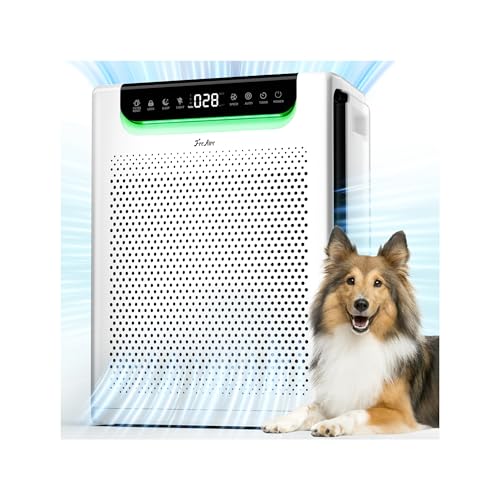
The HAP607 model targets expansive living areas, with purification capacity up to 2,600 ft². A front intake plus wider dual-side inlets maximize airflow, supported by a real-time PM2.5 sensor that powers Auto Mode for adaptive cleaning. A 99.97% HEPA filtration level helps tackle pet hair, smoke, and odors, making it suitable for homes with high activity and varied occupancy. The device also emphasizes energy efficiency and user-friendly operation through its display and auto-adjust features.
Potential drawbacks include the larger footprint and higher initial energy use during peak purification, balanced by faster cleanup in big rooms and when allergens are prevalent.
PuroAir 240: Trusted Large-Room Filtration

The PuroAir 240 HEPA purifier is engineered for large spaces up to 1,000 ft² with a robust 3-layer filtration system. It targets 99.9% pollutant filtration, including smoke, pollen, dust, and pet dander, and has undergone independent testing for performance. Certification by CARB, ETL, ISO, UL, and Energy Star supports its environmental and safety credentials. The unit’s design caters to bedrooms and living areas seeking reliable, science-backed air cleaning.
Users should evaluate ongoing filter costs, replacement intervals, and noise levels across fan speeds to ensure consistent comfort in bedrooms or family rooms.
Buying Guide: Key Purchase Considerations And Comparisons
When selecting an air purifier for home use, consider room size, filtration stages, and certification signals. AHAM VERIFIDE status provides an independent performance verification, helping buyers compare products beyond marketing claims. CADR ratings for smoke, dust, and pollen offer a practical sense of how fast a purifier cleans typical indoor pollutants.
Filtration stages matter: a true HEPA filter (or equivalent) captures 99.97% of 0.3-micron particles, while pre-filters catch larger debris and extend HEPA life. Activated carbon or deodorizing filters address odors and VOCs; triple-layer configurations often provide the best balance of performance and maintenance.
Real-time air quality monitoring and auto modes adjust fan speeds to match conditions, which can improve comfort and energy efficiency but may introduce more noticeable noise at higher settings. Washable pre-filters reduce ongoing costs and waste, though they require regular cleaning to maintain efficiency.
Coverage area should align with room size and layout. Purifiers designed for large rooms typically feature wider inflows and higher CADR, but ensure the unit fits the space’s dimensions and airflow patterns. Noise tolerance is essential in bedrooms and studies; review decibel ratings and sleep modes when quiet operation is a priority.
Maintenance planning is essential: estimate filter life, costs for replacements, and frequency of cleaning. Certifications from CARB, ETL, ISO, UL, and Energy Star signal compliance with safety and energy standards. Finally, assess smart features and software updates, compatibility with home ecosystems, and warranty terms to ensure long-term reliability.