Best Air Scrubbers for Mold Remediation
Air scrubbers with HEPA filtration are essential tools for mold remediation projects. They capture spores, reduce odors, and create a safer work environment by circulating clean air and preventing cross-contamination. This guide highlights five top options that balance filtration strength, portability, and durability for American job sites.
Summary table of chosen products:
| Product | Brand | CFM | Key Features |
|---|---|---|---|
| MOUNTO MT500 HEPA Air Scrubber | MOUNTO | ~550 CFM | Rotomolded shell, Daisy-chain outlets, variable speed, filter change light |
| VEVOR 3-Stage Air Scrubber | VEVOR | 550 CFM | Pre-filter, carbon, HEPA, durable copper motor |
| ALORAIR 3-Stage Scrubber | ALORAIR | Up to 550 CFM | Stackable, durable rotomolded shell, GFCI/indicator |
| PURAERO PA-600-HAS | PURAERO | 675 CFM | GFCI outlets, universal ducting, heavy-duty design |
| BlueDri Air Shield 550 | BlueDri | Up to 550 CFM | Three-stage purification, large room coverage |
These products cover typical mold remediation needs, from small rooms to larger industrial spaces. Each model emphasizes reliable filtration, ease of use, and the ability to daisy-chain units for higher airflow. Consider room size, filtration depth, and site requirements when choosing the right air scrubber for your project.
MOUNTO MT500 HEPA Air Scrubber
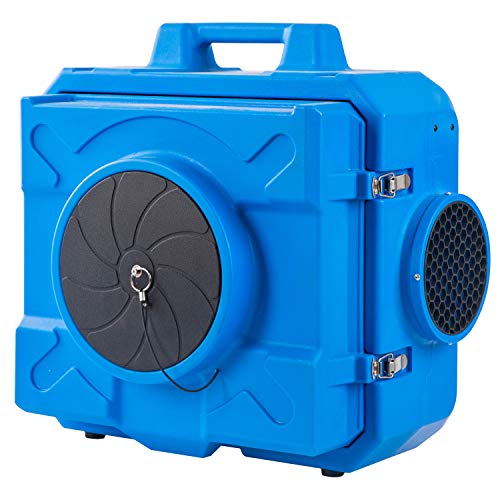
The MOUNTO MT500 is a portable air scrubber designed for rapid mold mitigation. It delivers approximately 550 CFM with a variable speed control, enabling operators to tailor airflow to the space. A built-in filter-change light helps track maintenance, while daisy-chain capable GFCI outlets support multi-unit setups. Its rotomolded construction combines durability with a lighter weight for moving between rooms. Quick filter access minimizes downtime during remediation tasks, and the compact form factor supports use in tight crawl spaces or apartments.
VEVOR Air Scrubber With 3-Stage Filtration

VEVOR’s 3-stage air scrubber combines a pre-filter (MERV-10), carbon filter, and HEPA (H13) filtration to remove dust, smoke, and odors. With a maximum airflow of about 550 CFM and a 2150 cubic-foot filtration area, it handles entire rooms efficiently. A copper motor design aims for durability and longer life. The user-friendly panel allows easy adjustment of airflow, timer, and overheat protection, plus a filter-change indicator to simplify maintenance during remediation work.
ALORAIR 3-Stage Stackable Scrubber
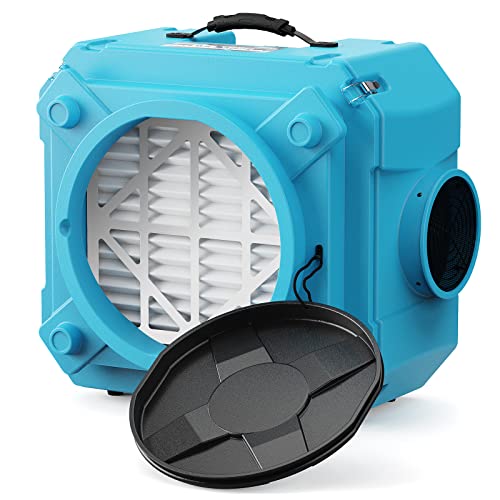
ALORAIR offers a robust 3-stage filtration system with a MERV-10 pre-filter, activated carbon, and HEPA filter capable of trapping 99.5% of particles larger than 0.3 microns. The rotomolded housing provides durability for construction sites and water/fire restoration tasks. The unit supports easy operation, a configurable airflow range up to 550 CFM, and a filter-change indicator. It’s designed for stacking up to three units to reach higher air cleaning rates in larger spaces.
CADPXS Shield-550 Air Scrubber

CADPXS Shield-550 combines a commercial-grade three-stage filtration with a robust pre-filter, HEP A, and carbon filter to tackle odors and fine particulates. It is designed for heavy-duty use in home repairs, sewage remediation, and water/fire restoration contexts. The filtration target aligns with mold remediation needs, capturing particles at 0.3 microns and above, while the unit’s construction emphasizes durability for challenging job sites.
MOUNTO MT500 (Green) Air Scrubber

The green variant of the MOUNTO MT500 offers the same core capabilities as the blue model: about 550 CFM airflow with variable speed, a filter-change indicator, daisy-chainable GFCI outlets, and rotomolded housing for durability. It remains a portable option suitable for moving between rooms during remediation projects, with easy filter access and a compact footprint for tight spaces.
Buying Guide: Key Considerations For Mold Remediation
When selecting an air scrubber for mold remediation, buyers should consider airflow capacity, filtration depth, durability, and on-site practicality. The following perspectives help compare common models:
- Filtration depth and stages: Models with 3-stage filtration (pre-filter, carbon, HEPA) typically perform best against mold spores and odors. Look for HEPA efficiency rated at 99.97% for 0.3-micron particles or better.
- Airflow and room size: Higher CFM provides faster clearance in larger rooms. For typical residential spaces, 500–800 CFM is common; for large commercial spaces, consider multiple units or higher-capacity machines.
- Durability and construction: Rotomolded housings and rugged frames withstand job-site abuse and frequent transport between rooms or sites.
- Portability and setup: Lightweight designs, wheels, and compact footprints help crews move units easily. Daisy-chain outlets facilitate multi-unit configurations without extra power strips.
- Maintenance indicators: Filter-change lights and easy-access panels reduce downtime and ensure continuous air cleaning during remediation tasks.
- Ducting compatibility: On many projects, rapid negative-air setup requires standard ducting. Units with universal duct connections and wraparound cord storage save time on site.
- Energy and noise: Power consumption and noise levels matter for occupied spaces. Adjustable speed control helps balance effectiveness with comfort or client needs.
- Size and layout: Measure the space to determine required CFM. Large open areas may need multiple scrubbers or higher-capacity machines.
- Odor control: If strong odors accompany mold, prioritize a unit with carbon filtration to neutralize smells in addition to spores.
- Compatibility: Confirm the unit supports common ducting sizes and has accessible replacement filters in your region.
- Maintenance planning: Schedule filter changes and bagging procedures to minimize secondary contamination during remediation.
- Compliance and safety: Ensure units meet local regulations and have built-in safety features like overheat protection and GFCI outlets.
In practice, a two-unit setup at moderate CFM can reduce remediation time, especially when working in multiple rooms or stories. Always pair air scrubbers with containment practices, negative air pressure, and thorough cleanup protocols to manage mold effectively and safely.