If you’re shopping for a 120-volt baseboard heater, you want reliable warmth, straightforward installation, and clear performance for your space. This guide highlights five top options that suit common rooms like living areas, bedrooms, and home offices. Each entry is evaluated for best use case, ease of use, and any limitations. The following picks balance affordability, steady convection heating, and simple mounting or plug-in setup to fit US homes.
Summary of chosen products at a glance:
| Product | Best For | Key Power | Notes |
|---|---|---|---|
| Cadet Baseboard Heater Ul 120 V/4.17 A White 30″ | All‑round living spaces | 500 W | Remote control, floor mounting |
| Cadet F Series 72″ 120V 1500W | Larger rooms, continuous heat | 1500 W | Extended length for even warmth |
| Cadet F Series 36″ 120V 750W | Medium rooms, retrofit projects | 750 W | Thermostat required |
| MOLLIFII 48″ 1000W 120V | Mid-sized rooms, budget-friendly | 1000 W | White finish, straightforward install |
| Stelpro Brava 1500W 120V 72″ | Quiet, high-output spaces | 1500 W | Hardwired, advanced control options |
Cadet Baseboard Heater Ul 120 V/4.17 A White 30″ 500 W

Best for compact spaces or zones where you want steady low-profile heat. This Cadet model delivers 500 W of convection heat, suitable for small living rooms, bedrooms, or home offices seeking consistent warmth without noise. It’s designed for floor mounting and can be installed with two units for flexible placement. A remote control adds convenient temperature adjustment from across the room.
Who this is for: buyers needing a compact 120 V heater with remote control and simple floor mounting. Why selected: its balance of power, ease of installation, and quiet operation makes it versatile for smaller rooms.
Limitations: 500 W may be insufficient for large spaces without multiple units or supplemental heating.
Cadet F Series 72 in. Electric Baseboard Heater

This long baseboard heater is designed to spread heat across a large wall, ideal for bigger living rooms or open-plan spaces. With 1500 W at 120 V, it aims to sustain comfortable temperatures in areas up to substantial square footage when installed in a line with your room’s climate needs. The model is described as continuously transmitting heat and commonly used where a steady, even temperature is desired.
Who this is for: larger rooms needing robust convection heat. Why selected: its extended length helps reduce cool spots along the wall and maintains even warmth.
Limitations: this unit is typically not plug-in; it may require a dedicated thermostat integration for optimal control, depending on installation.
Cadet F Series 36″ Electric Baseboard Heater
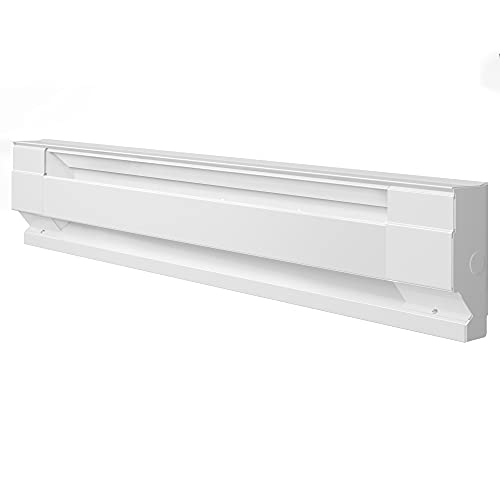
With a 750 W output, this Cadet model fits medium-sized rooms and spaces where a thinner, shorter heater is preferable. It includes a robust metal construction and requires a thermostat to control temperature, which can help maintain comfort and energy efficiency. It is powder-coated for durability and designed for clean, continuous heat.
Who this is for: retrofit projects or rooms needing a compact, capable heater. Why selected: offers a practical balance of size, heat output, and control requirements.
Limitations: not inherently a plug-in unit; thermostat pairing is necessary for temperature management.
48″ Electric Baseboard Heater, MFR: 4F1000-1W-A

This 48-inch unit provides 1000 W of heat, a solid choice for mid-sized rooms wanting reliable warmth with a tidy, low-profile look. The model is listed with easy installation in white finish and a straightforward electrical setup. It’s suitable for spaces where wall-to-wall heating coverage is beneficial without a bulky radiator footprint.
Who this is for: budget-conscious buyers needing a mid-length heater with strong output. Why selected: good balance of length, heat output, and a clean aesthetic.
Limitations: may require a thermostat for efficient control, depending on installation requirements.
Stelpro Brava Electric Baseboard Heater – 1500W

The Stelpro Brava provides high-output convection heating with 1500 W at 120 V. It is designed as a hardwired heater, not a plug-in unit, and offers multiple control options via compatible wall thermostats or optional built-in kits. The unit emphasizes quiet operation and a clean, no-end-cap design for reduced noise and a streamlined look.
Who this is for: spaces requiring substantial heat with a discrete appearance and flexible control options. Why selected: best suited for rooms where a powerful, steady heat source is preferred and hardwired installation is feasible.
Limitations: not plug-in; installation requires compatible thermostat and wiring considerations.
King Electric 2K1205-BW K Series Baseboard Heater

This 27-inch heater provides 500 W at 120 V, a compact option suitable for small to medium spaces or as supplemental heat. Its back wire design and built-in cable clamps support neat, secure installation, and the unit’s crushproof element reduces risk of accidental damage during setup and use.
Who this is for: small rooms or zones needing additional heat with easy installation. Why selected: compact footprint, straightforward wiring, and practical safety features.
Limitations: limited heat output compared to larger models; may not be sufficient for large rooms without additional units.
King 3K1207BW 750-Watt Baseboard Heater
With 750 W at 120 V, this King heater provides mid-range performance for small- to mid-sized rooms. Notable features include an aluminum ribbon fin element for efficient heat transfer, a full-length safety cutout, and a crushproof element. It’s a straightforward solution for rooms needing reliable warmth without upgrading electrical service.
Who this is for: budget-friendly, mid-output heating in smaller living spaces. Why selected: reliable baseline heat and compact enclosure with practical safety features.
Limitations: may not meet higher heat requirements in very large rooms without additional units.
Buying Guide
What should you consider when choosing a 120-volt baseboard heater?
- Room size and heat needs: Larger spaces typically benefit from higher wattage or longer models to distribute heat evenly. For big rooms, a 1500 W unit or multiple units can provide consistent warmth.
- Installation type: Decide between plug-in models for quick setup and hardwired units for permanent installations and potentially more precise climate control.
- Thermostat and controls: Some units require a separate thermostat; others include remote control. Consider whether enhanced control, zoning, or smart thermostats matter to you.
- Finish and footprint: Choose a length that aligns with your wall space and aesthetic. White finishes blend with most interiors, while longer units offer uniform heat distribution along walls.
- Durability and build: Powder-coated or metal casings enhance longevity. Look for units designed for easy mounting and cable management in living areas, bedrooms, or home offices.
How to compare models quickly
- Power output (W): 500–1500W covers most small to large rooms.
- Length (in): Longer heaters heat more evenly across a wall.
- Plug-in vs hardwired: Plug-in is easier; hardwired supports centralized control.
- Thermostat compatibility: Determine if the unit includes a thermostat or requires one.
- Noise: Baseboard heaters are typically silent; verify if your space requires near-silent operation.
FAQ
- Q: Do 120-volt baseboard heaters require professional installation? A: Plug-in models can often be installed by homeowners, while hardwired units may require an electrician.
- Q: Can these heaters heat an entire house? A: They are best for individual rooms or zones; multiple units are typically used for whole-home comfort.
- Q: Are baseboard heaters energy efficient? A: Efficiency depends on room isolation, thermostat control, and proper sizing. Larger, well-controlled units can be effective for steady, even heating.
- Q: Can I install more than one baseboard heater on the same circuit? A: Yes, but ensure your circuit amperage and house electrical guidelines accommodate the load and wire gauges.
- Q: What maintenance is required? A: Wipe dust from fins and ensure thermostats and wiring are in good condition; consult an electrician if you notice any electrical issues.
- Q: Are these models compatible with smart thermostats? A: Some models support integration via standard wall thermostats; check compatibility with your preferred smart thermostat.