Looking for a reliable 220-volt electric baseboard heater that delivers steady warmth without noise or fuss? This guide highlights five top options, noting who each heater is best for and why. It helps buyers choose based on room size, wiring options, and installation needs. The list focuses on models with solid convection heat, straightforward wiring, and safety features to fit typical American homes.
Overview of selected products:
- Cadet F Series 36″ Electric Baseboard Heater (3F750W) — best for larger rooms that need a steady 750-watt heat boost.
- Cadet F Series 24″ Electric Baseboard Heater (2F350W) — best for small bedrooms or compact spaces.
- Cadet F Series 48″ Electric Baseboard Heater (4F1000W) — best for medium rooms needing strong heat at 1000 watts.
- Stelpro Brava Electric Baseboard Heater — best for quiet operation and modern aesthetics in bedrooms or offices.
- Cadet Convection Baseboard Heater — best for simple, reliable space heating in living areas.
| Product | Watts / BTU | Voltage | Best For |
|---|---|---|---|
| Cadet F Series 36″ (3F750W) | 750W / 2560 BTU | 240/208V | Larger rooms, consistent convection heat |
| Cadet F Series 24″ (2F350W) | 350W / 1195 BTU | 240/208V | Small bedrooms, compact spaces |
| Cadet F Series 48″ (4F1000W) | 1000W / 3415 BTU | 240/208V | Medium rooms, stronger heat |
| Stelpro Brava 1250W | 1250W | 240V | Quiet operation, modern look |
| Cadet Convection 1000W | 1000W | 120V | Indoor living areas, easy installation |
Cadet F Series 36″ Electric Baseboard Heater

Model 3F750W provides flexible heating with dual wattage options (750/563W) across 240/208V. Its convection design circulates warm air, helping maintain comfortable temperatures with minimal noise. Best for: spaces where consistent heat and simple wiring are priorities, such as living rooms or open-concept spaces. Limitation: not ideal for spaces requiring plug-and-play flexibility; installation assumes fixed mounting and proper wiring.
Cadet F Series 24″ Electric Baseboard Heater

This model offers compact sizing with 350W (262W on 208V) capability, suitable for small bedrooms or offices where space is at a premium. Best for: supplementary heat in tight layouts or rooms that don’t require high-output heaters. Limitation: lower wattage means slower warm-up in larger spaces.
Cadet F Series 48″ Electric Baseboard Heater
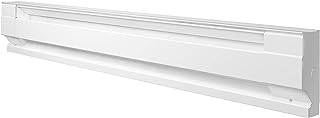
With 1000W (750W on 208V) across 240/208V, this heater delivers robust warmth for small to medium rooms. It features universal wiring and pre-punched knockouts for straightforward wall or floor mounting. Best for: medium-sized spaces needing reliable, high-output heat. Limitation: higher wattage may require dedicated circuit capacity.
Stelpro Brava Electric Baseboard Heater

1250W on a 240V circuit provides ample heat for bedrooms and home offices. Silent, one-piece steel construction reduces ticking and pops common with two-piece designs. Best for: bedrooms or quiet zones where a softly heated environment is preferred. Limitation: requires external thermostat control and is not a plug-in unit.
Cadet Convection Baseboard Heater

This 1000W electric baseboard heater delivers efficient radiant and convection heat for spaces up to 175 sq ft. Wall-mounted design saves floor space and blends with interiors. Best for: living rooms or larger bedrooms where wall mounting is preferred. Limitation: 120V operation limits compatibility with 240V circuits.
Buying Guide
What to consider when choosing a 220V baseboard heater:
- Room size and heat load: Larger rooms benefit from higher wattage units (750-1000W) while small spaces can use lower wattage models (350-500W).
- Wiring and installation: Look for models with universal wiring and pre-punched knockouts to simplify mounting. If you lack dedicated 240V circuits, consider 120V options only as needed.
- Convection vs radiant: Most baseboards rely on convection for even room warming. Radiant emphasis can differ by model; choose based on preferred heat feel.
- Noise and security: Quiet, single-piece cabinet designs reduce ticking sounds and improve safety for homes with kids or pets.
- Thermostat control: Some units require external thermostats; others pair with built-in options. Decide whether to pair with a dedicated thermostat for precise control.
- Safety features: Look for high-temperature shutoff or overheat protection to minimize risk in warm rooms or near furniture.
FAQ
- Can I replace a 220V baseboard heater with a 120V model?
Answer: No, 120V models require different wiring and will not safely operate on 240V circuits. - Is external thermostat compatible with all baseboard heaters?
Answer: Not all, some require thermostats sold separately; check product details for compatibility. - Which heater is best for a large family room?
Answer: Heaters with 1000W or more (e.g., 4F1000W or 1250W models) typically provide better room coverage. - Are baseboard heaters noisy?
Answer: Well-designed single-piece enclosures reduce ticking and popping; Stelpro Brava is promoted for silent operation. - Do these units require professional installation?
Answer: Installation complexity varies; universal wiring and pre-punched knockouts simplify mounting, but electrical wiring should follow local codes. - Can I use multiple heaters in the same room?
Answer: Yes, but sum the wattage to avoid overloading circuits; a professional should confirm electrical capacity.