Answering the need for reliable 240V heating control, this guide highlights five practical options. These picks suit DIY aficionados, home brewers, aquarists, and anyone replacing or upgrading heat control in 240V systems. Each entry explains who benefits most, why it was selected, and a clear caution to help avoid common missteps. A concise buying table follows to compare core details at a glance.
| Product | Best For | Key Advantage |
|---|---|---|
| PID Temperature Controller Kit, CGELE | Home brewers, small-scale labs, DIY temperature control | Includes SSR, thermocouple, and heatsink for an all-in-one control solution |
| bayite BTC211 Dual Digital Outlet Thermostat | Fermentation, aquariums, fermentation, BBQ/cropping setups | Dual relays for simultaneous heating and cooling control |
| Blichmann Electric Element Power Controller | Brewing, lab heating where rapid, smooth power ramp is key | Precise 0–100% power control with quick-response knob |
| Rheem SP10552MH 4500W 240V Element | Water heater replacements and high-power 240V heating | High wattage for fast heating in 240V systems |
| HE 90240 9KW 240V Tankless Water Heater Elements (3-pack) | Multiple 240V tankless setups needing robust copper elements | High power, copper with oxidation-resistant coating for durability |
Note: Each product is evaluated for its relevance to 240V heating control and element replacement. The list includes both control modules and heating elements, since many buyers look for complementary components to complete a 240V heating setup.
PID Temperature Controller Kit: CGELE With SSR And Thermocouple
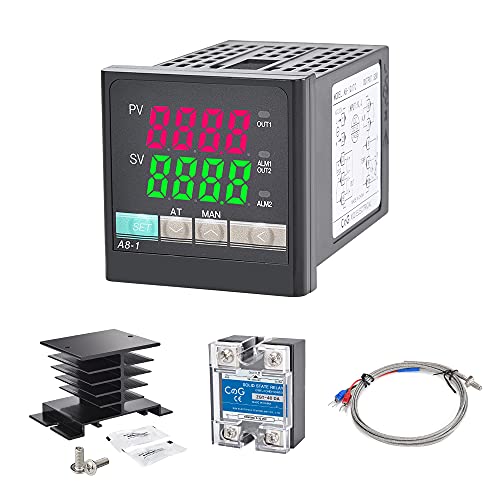
This PID controller kit is designed for 100–240V AC input systems and includes a 40DA SSR, a K-type thermocouple, and a black heat sink. Best for users who want a ready-to-connect control package with alarm output and 3-wire sensor compatibility. The alarm relay supports common signaling for alerts. Choose this if you need a compact, all-in-one control unit for precise temperature management in heating applications. Caution: Verify SSR compatibility with your load and ensure proper isolation to avoid electrical hazards.
bayite BTC211 Dual Digital Outlet Thermostat
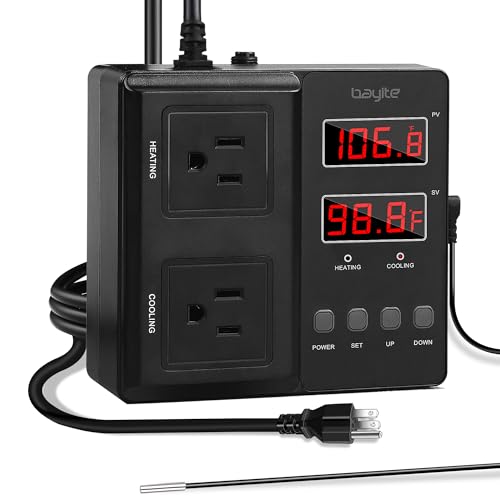
The bayite BTC211 provides dual relays for simultaneous heating and cooling control on 110–240V systems. It displays real-time temperature and setpoint, enabling straightforward operation for fermentation, BBQ setups, or reptile habitats. Best for users who want plug-and-play simplicity and the option to drive two separate heating elements or coolers from one device. Better for environments needing quick, separate control channels. Limitation: Maximum output per channel may cap total load when both channels run at high power.
Blichmann Electric Element Power Controller

This 240V power controller provides precise power regulation from 0 to 100% with a fast-acting knob. It’s designed for equipment where steady, smooth power delivery matters more than direct temperature feedback, which makes it ideal for brewing kettles or test rigs where thermal load can vary. Best for users who want tight control of heating elements without embedded temperature sensors. Caution: It does not read or control temperature by itself—additional temperature feedback is required for closed-loop control.
Rheem SP10552MH 240V 4500W Heating Element

This resistored, 240V heating element provides 4500W of heat for water heaters or similar 240V systems. It is suitable for high-demand heating replacements in residential uses where a straightforward element swap is required. Best for upgrading an existing 240V heater with a robust, standard-size element. Caution: Verify compatibility with your tank and ensure correct watt-density matching to your water heater model.
HE 90240 9KW 240V Tankless Heater Elements (3-Pack)

This kit includes three 9KW 240V copper heating elements compatible with EcoSmart, Eemax, iHeat/Drakken, Rheem, and Richmond models. It emphasizes high-temperature tolerance and corrosion resistance with an oxidation-resistant coating. Best for multi-point installations requiring robust, long-lasting elements. Choose this if you need a cost-effective 3-pack for spare elements or multi-zone heating. Caution: High current draw requires secure wire harness connections to prevent loose terminations under load.
Buying Guide: Key Considerations For 240V Heating Control And Elements
What will you heat, and how precise must the temperature be? For precise temperature control, a PID controller with a compatible sensor and SSR is ideal. If you only need power on/off or dual-channel control, dual-relay controllers or simple power controllers can be enough. For heating elements, confirm voltage, wattage, and thread size to ensure a proper fit. When integrating controllers with heaters, check SSR ratings, wiring separation, and enclosure safety to prevent shock or fire risk. Consider expandability: DIN-rail mounting and modular relays can simplify future upgrades. For breweries, fermentation, or aquariums, align the control method with the system’s heat ramp requirements and stability needs.
Frequently Asked Questions
- What is a 240V heating element controller? – It’s a device that modulates power to a heating element connected to a 240V supply, often using a thermostat, PID loop, or power controller to maintain a set temperature.
- Do I need a temperature sensor with a PID controller? – Yes. Most PID setups require a temperature sensor (thermocouple or RTD) to provide feedback for accurate control.
- Can I use any 240V heating element with a controller? – Compatibility depends on wattage, thread size, and electrical load. Always match element specifications to the controller’s output rating.
- Is dual-relay good for both heating and cooling? – Dual-relay controllers are convenient when you need separate control paths for heating and cooling in the same system.
- What safety steps are essential? – Use proper enclosures, correct gauge wiring, adequate grounding, and overcurrent protection. Follow manufacturer wiring diagrams precisely.
- Can I install these devices myself? – Basic electrical projects can be DIY with proper knowledge and safety; complex systems should be installed by a licensed professional.