Best 80 Gallon Expansion Tank Options for Residential Water Heating Systems
When your goal is reliable thermal expansion control for a larger home or a high-demand system, an 80 gallon-capacity expansion tank can help protect your water heater and plumbing from pressure spikes. This guide highlights five solid choices, detailing who they’re best for and what to watch out for. If you’re upgrading a tank or installing a system with a high volume of hot water, these models are worth considering for durability, compatibility, and installation ease.
The following table summarizes the five selected products. It’s designed to help you compare capacity, connection types, and best-use scenarios at a glance.
| Product | Capacity | Connection | Best For |
|---|---|---|---|
| Watts ETX-30 | 4.7 gallons | 1/2″ MNPT | Commercial or residential closed-loop systems needing high capacity and robust construction. |
| TT FLEX 4.5 Gallon | 4.5 gallons | 3/4″ MNPT | Extended hot-water systems with space for a larger tank and corrosion resistance needs. |
| TT FLEX 2.1 Gallon | 2.1 gallons | 3/4″ MNPT | Smaller spaces or secondary heater setups needing compact expansion management. |
| EFIELD 2.1 Gallon | 2.1 gallons | 3/4″ MNPT | Potable water applications with straightforward installation for newer systems. |
| GUOFIS 2.1 Gallon | 2.1 gallons | 3/4″ MNPT | DIY-friendly installs requiring safe potable water compliance. |
Watts ETX-30 Non-Potable Expansion Tank

Best for: Larger residential or small commercial closed-loop hydronic systems that require high-volume expansion management. This tank offers a large 4.7 gallon capacity and carbon steel construction with an epoxy finish for durability in demanding environments. The 1/2″ MNPT connection is common in many existing installations, allowing straightforward retrofits or new builds.
Why selected: Its generous volume helps absorb significant thermal expansion, reducing the risk of valve leaks or pressure spikes in busy hot-water networks. The robust build suits longer runs and higher flow demands.
Caution: This is a non-potable model; ensure it’s suitable for your system’s water quality and usage to avoid any compatibility concerns with drinking water setups.
TT FLEX 4.5 Gallon Potable Expansion Tank
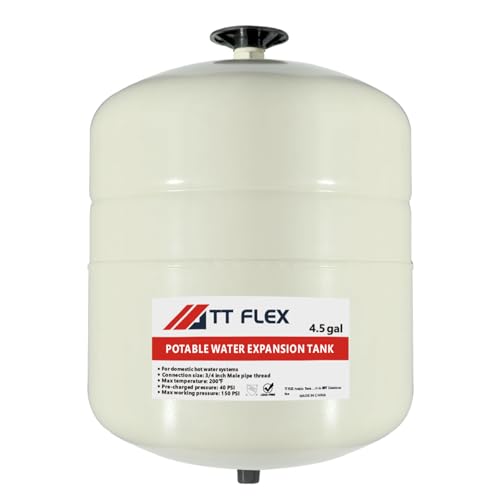
Best for: Homeowners seeking corrosion-resistant, inline expansion protection for a potable water heating system with a larger footprint. This unit uses a 100% butyl diaphragm and plastic liner to separate system water from precharged air, improving longevity in typical residential usage.
Why selected: The design minimizes external corrosion and rust and offers an easy installation path for contractors and DIYers alike. It’s well-suited for households requiring reliable thermal-expansion control in a robust package.
Limitation: The 4.5 gallon capacity may be overkill for very small or space-constrained installations; verify space and need before choosing.
2.1 Gallon Accumulator Expansion Tank

Best for: Homes with compact spaces or smaller heating/cooling setups requiring efficient thermal expansion control without excessive footprint. The 2.1 gallon capacity fits tight installations while providing essential protection.
Why selected: It’s DIY-friendly with a universal 3/4″ MNPT connection and a pre-charge setup suitable for common water-heater installations. It also emphasizes safe potable-water use through a high-grade diaphragm.
Caution: The smaller capacity means it may need more frequent monitoring or replacements in very high-use systems compared with larger tanks.
Usknxiu Well Pressure Tank with Installation Kit

Best for: Home systems that require automatic pressure regulation and a compact package with an included installation kit. The safety valve feature helps vent excess pressure, and the unit is designed to handle both pressure regulation and water storage needs.
Why selected: Its automatic operation minimizes manual adjustments, supporting efficient water pressure management. The included safety valve and negative pressure valve help prevent tank damage during pressure fluctuations.
Caution: The effective water storage capacity is typically 50-70% of the labeled volume due to air precharge; plan capacity needs accordingly to avoid under-sizing your system.
Buying Guide
What size expansion tank do I need for an 80 gallon system?
For an 80 gallon system, prioritize tanks with larger capacities (around 4 gallons or more) to handle significant thermal expansion. If space is limited, pairing a smaller tank with periodic checks may be necessary, but larger capacity generally reduces the risk of relief valve activations.
Should I choose potable-water rated or non-potable tanks?
Choose potable-water rated tanks when the expansion tank will be in contact with drinking water. Use non-potable tanks for systems where water safety standards do not apply to the tank contents. In residential homes with hot water as the primary supply, potable-rated options are typically preferred.
What connection size do most 80 gallon systems use?
Most standard domestic expansion tanks use 3/4″ MNPT connections, simplifying installation on common water heaters and supply lines. Verify your hardware before purchasing to ensure compatibility.
What are common installation considerations?
Ensure the tank is mounted in a location with adequate support and accessibility for maintenance. Check space for the tank’s diameter and height, and confirm that the installed orientation aligns with the system’s piping layout. For closed-loop heating systems, verify that the tank is suitable for the intended operating pressure range.
Do I need professional installation?
Professional installation is recommended for systems with multiple loops, high pressure requirements, or complex plumbing. DIY installs are feasible for straightforward configurations with standard fittings, but proper sealing, venting, and pressure testing are essential for safety and performance.
What maintenance is required?
Routine inspection should include checking the pre-charge pressure, visual inspection for leaks, and confirming that the relief valve provisions function as designed. Replacement intervals may vary by model and usage; consult the manufacturer guidance for specific maintenance timelines.
How do I compare these options effectively?
Compare capacity, connection type, material durability, and whether the tank is rated for potable water. Consider space availability, the typical daily hot-water demand, and whether you need a tank with a robust diaphragm or corrosion-resistant components, especially in warmer climates or harsh water conditions.
FAQ
- What is the purpose of an expansion tank in an 80 gallon system? It absorbs excess thermal pressure to protect the water heater and piping from damage.
- Can I install an expansion tank myself? Yes, for simple setups with standard fittings and clear instructions. For complex or multi-loop systems, professional installation is advised.
- Is a larger tank always better? Generally, a larger tank provides more protection, but it also requires more space and cost. Choose based on system demand and available space.
- What does MNPT mean? It stands for male National Pipe Thread, a standard thread type for plumbing fittings.
- Are potable and non-potable tanks interchangeable? Not in drinking-water scenarios; use potable-rated tanks for drinking-water systems to ensure safety.
- How do I determine capacity needs? Consider the hot-water draw rate, system pressure, and the expected thermal expansion from the heater’s operating temperatures.