Looking for an app-controlled space heater? This guide highlights five models that offer Wi‑Fi or app integration, plus safety features and flexible controls. Best for tech-savvy buyers who want remote operation, voice control, and programmable schedules. If you need quiet operation for a bedroom, or broad warmth for a living room, these options cover common spaces and use cases. The quick-reference table below summarizes the top picks and who they suit.
| Product | Best For |
|---|---|
| SereneLife Smart Space Heater | Smart, app-enabled heating with remote control; ideal for bedrooms and living rooms |
| NUTROMO Space Heater | Full smart home integration with Alexa/Google; versatile for homes with voice control |
| MORENTO Space Heater | Quiet operation and app control; suitable for bedrooms and offices |
| DREO Space Heater | Fast warm-up with tilt feature; good for desks and workspaces |
| FLANUR 1500W Smart Space Heater | Large-room heating with app control and 70° oscillation |
SereneLife Smart Space Heater Review
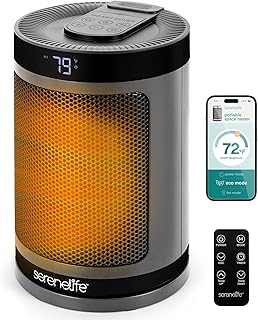
The SereneLife 1500W PTC ceramic heater heats spaces quickly and evenly, making it suitable for larger rooms. It features Wi‑Fi app control and a remote for adjusting temperature, timers, and modes from anywhere. Safety features include overheat protection, tip-over safety, and a child lock, which is attractive for homes with kids or pets. This model suits buyers who want convenient, integrated control from a smartphone and a dependable heater for living rooms or home offices. Caution: Ensure the heater is placed on a flat surface away from flammable materials.
NUTROMO Space Heater With WiFi And Voice Control

The NUTROMO heater emphasizes smart life integration, offering app control and compatibility with Alexa and Google Assistant. It supports 1500W high‑efficiency heating with a wide 75° oscillation to distribute warmth across larger spaces. Best for users who want voice and app control in a connected home and the ability to manage climate from anywhere. Limitation: The unit requires a stable 2.4 GHz Wi‑Fi connection for full functionality.
MORENTO Space Heaters For Indoor Use

MORENTO offers smart control with 2.4G Wi‑Fi, remote app access, and voice control via Alexa and Google Home. It includes a 12‑hour timer and a dual‑mode setup for heating and cooling, with child lock and anti‑tip protections. It’s best for users who want a quiet, versatile heater that can double as a portable climate control device across seasons. Caution: The LED display and audible cues can be distracting for light sleepers; mute option helps mitigate this.
DREO Space Heater 1500W With Tilt

The DREO heater emphasizes a vertical tilt feature (0°–60°) to deliver warmth where needed, plus 1500W rapid heating. It includes robust safety features such as tip‑over protection, overheat protection, and a flame‑retardant cabinet with ETL certification. Best for desks or floor spaces where directional warmth matters. Limitation: It lacks built‑in Wi‑Fi control; manual adjustments may be necessary in some setups.
FLANUR 1500W Smart Space Heater

FLANUR’s heater delivers 1500W PTC ceramic heating with 70° oscillation for broad room coverage. It includes app control via Havaworks, compatibility with Alexa and Google Assistant, and a memory function to restore settings. It’s best for large rooms or offices that need consistent warmth with smart scheduling. Caution: The unit’s screen can be dimmed or turned off for quiet operation, which may reduce on‑screen feedback during use.
Buying Guide: Key Considerations For App-Controlled Heaters
What room size will you heat? Choose a model with appropriate wattage and oscillation to cover the space. Large rooms benefit from 1500W units with wide oscillation; smaller rooms can use compact models.
How important is app control and voice integration? If you want remote scheduling and voice commands, prioritize models with robust smart features and reliable app performance.
What safety features matter? Look for overheat protection, tip‑over sensors, child locks, and sturdy construction. These features are crucial in homes with kids or pets.
Does quiet operation matter? For bedrooms or study spaces, select models advertising low noise (often under 40 dB). Some units offer a mute option for the display and sound.
Is 2.4 GHz Wi‑Fi required? Most smart heaters use 2.4 GHz networks for reliable connectivity. Confirm compatibility before setup.
How to use and maintain an app-controlled heater
- Install in a stable location away from curtains and clutter.
- Connect to your home Wi‑Fi using the manufacturer’s app and complete any setup steps for schedules.
- Configure timer and modes to match daily routines for energy savings.
- Regularly clean air vents and ensure safety features are functioning.
Who should consider these heaters?
- Remote workers needing a warm desk or office space with voice and app control.
- Homeowners seeking energy‑efficient room heating with scheduling.
- Families with children or pets who require built‑in safety protections.
Frequently Asked Questions
- Do app-controlled heaters consume more energy? Energy use depends on the selected heat setting and usage patterns; app control helps optimize schedules to save energy.
- Can I control these heaters with voice assistants? Most models listed support Alexa and Google Assistant through their apps or integrations.
- Are these heaters safe for bedrooms? Yes, provided you follow safety guidelines and keep clearances around the unit; many include tip‑over and overheat protection.
- What if my Wi‑Fi is unstable? Manual controls on the unit can be used, but app features may be limited during outages.
- Will these work in small apartments? Yes, select compact 1500W units with adjustable oscillation; for very small spaces, a lower wattage or thermal balance is usually sufficient.
- How do I choose between 70° vs 75° oscillation? A wider angle distributes heat more evenly in larger rooms; smaller rooms may not need the full range.