Finding the right basement floor heating system starts with knowing what you need: consistent warmth, easy installation, and safe operation in damp spaces. This guide highlights five top options that suit basements well, from large-area mats to compact kits. Best for remodeling projects, best for DIY install, or best for quick warm-up—each product is chosen for reliability, controllability, and safe operation in moisture-prone areas. Below is a quick summary table of the featured products to help you compare at a glance.
| Product | Best For | Size / Coverage | Key Feature |
|---|---|---|---|
| BLARALA Electric Radiant Floor Heating System | Large basement areas | 100 sq ft | Programmable thermostat with floor sensor |
| LuxHeat 90sqft Electric Floor Heating System | Customizable layouts | 90 sq ft | 3-in-1 design with uncoupling membrane |
| Warming Systems 30 Sq Ft Mat Kit | Smaller zones or partial renovation | 30 sq ft | Premium touchscreen thermostat, easy install |
| LuxHeat 25sqft Electric System | Mid-size basements | 25 sq ft | Undersfloor anti-crack design with GFCI thermostat |
| LuxHeat 10 Sqft Floor Heating System | Targeted warmth or retrofit projects | 10 sq ft | WiFi thermostat for remote control |
BLARALA Electric Radiant Floor Heating System

The BLARALA system is designed for up to 100 square feet and includes a programmable thermostat with floor sensor. It is suited for bathrooms and finished basements where tile or laminate is installed, offering floor-level comfort and multiple operating modes for energy efficiency. The included monitor helps detect installation issues and prevent overheating. This option is best for homeowners who want a robust, all-in-one kit with safety features and clear floor-sensing control. A potential limitation is the need for proper subfloor preparation to ensure consistent heat transfer.
LuxHeat 90sqft Electric Radiant Floor Heating System

The LuxHeat 90sqft kit is designed for larger basement zones and includes a UDG4 programmable thermostat with dual sensors, a dedicated uncoupling membrane, and an alarm. Its design emphasizes flexibility and long-term installation reliability, with a 7-day programming schedule and a warranty. It’s a strong pick for remodelers who want a 3-in-1 solution—heat, crack prevention, and waterproofing—under tile or vinyl flooring. For best results, follow the membrane instructions and ensure proper embedding in a suitable thinset or self-leveler.
Warming Systems 30 Sq Ft Mat Kit

This kit provides a compact 30 sq ft heating mat paired with a premium touchscreen thermostat and a warning monitor. It’s best for isolated areas such as a bathroom or a small basement corner where precise heat is needed without heating an entire space. The included thermostat supports a 7-day program and dual sensing, offering precise comfort and safety. A limitation is the smaller coverage area, which may require multiple mats to heat larger basements evenly.
LuxHeat 25sqft Electric Radiant Floor System
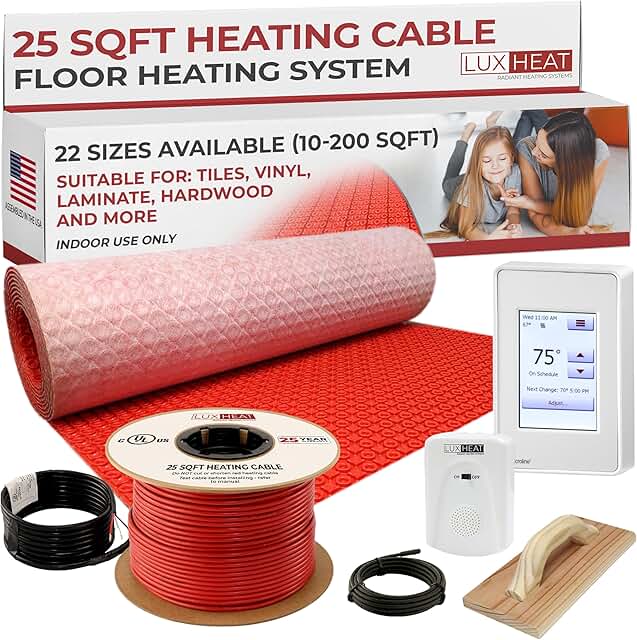
Designed for mid-size basements, this LuxHeat kit offers a 25 sq ft heating cable and a 7-day programmable thermostat with GFCI. The included uncoupling membrane aids crack prevention and provides a clean installation path under tile or other compatible flooring. It’s best for homeowners who want a balance of ease of installation and flexible layout. Use caution with larger area expansion; additional mats may be needed for full-room coverage.
LuxHeat 10 sqft Floor Heating System

This compact kit targets small zones or retrofit projects with 10 sq ft of heating area and a WiFi-enabled OJ Microline thermostat. It’s ideal for adding warmth to a bathroom nook or under a floating vanity. The WiFi thermostat supports remote control and energy management. Avoid this if you need to heat a whole basement space; larger systems provide more uniform coverage for chillier rooms.
Buying Guide
What should you consider before buying a basement floor heating system?
- Coverage area: Measure the space and choose a system that matches or can be combined with additional mats for even heat distribution.
- Thermostat features: Look for programmable, touchscreen controls, dual sensing (air and floor), and GFCI protection for safety in damp spaces.
- Installation: Some kits include uncoupling membranes or additional underlayment. Ensure subfloor compatibility (tile, laminate, wood) and whether self-leveling compound is required.
- Safety and durability: Check for CSA or UL listings and moisture-rated components. An alarm or monitor helps detect damage during installation.
- Maintenance and warranty: Consider long-term warranties and ease of thermostat replacement or sensor maintenance.
- Energy efficiency: Programs and sensor integration help reduce energy use. A system with floor sensing typically improves comfort at lower thermostat settings.
FAQ
- Q: Do these systems work well in basements with concrete slabs?
A: Yes, most systems are designed for concrete slabs under tile or veneer flooring, but ensure proper insulation and subfloor preparation for even heat transfer. - Q: Is professional installation required?
A: It varies by product. Some kits are DIY-friendly with clear installation guides, while others may benefit from a licensed installer for complex layouts. - Q: Can I use these systems under carpet?
A: Some systems are suitable under certain types of flooring, but most manufacturers emphasize tile or laminate installations. Check each kit’s flooring compatibility. - Q: Do the thermostats support smart home integration?
A: Several kits include WiFi-enabled thermostats or touchscreen controls that permit remote operation and scheduling. - Q: What safety features should I look for?
A: Look for GFCI protection, floor sensors, auto shutoff, and alarms or monitors to detect overheating or wire damage. - Q: Can I expand coverage later if my basement area changes?
A: Some systems allow adding additional mats or sections, but verify compatibility with the existing thermostat and wiring.