Answering the search intent for reliable propane space heaters, this guide highlights five top options designed for large areas. These fan-forced units are best for workshops, garages, barns, and open outdoor spaces with proper ventilation. The selections emphasize output range, safety features, and practical use cases to help buyers choose the right heater for big rooms or job sites. Below is a quick summary table and why each model stands out for specific needs.
| Product | Best For | Key Strength |
|---|---|---|
| Remington LP Forced Air Heater | Medium-to-large spaces up to 1,500 sq ft | Great balance of heat output and portability |
| VEVOR 125,000 BTU Propane Heater | Very large spaces & high-altitude use | Highest output in this list with robust protection |
| Flame King 60,000 BTU | Open garages and patios | Compact, durable, with safety features |
| Mr Heater 125,000 BTU | Large workshops & warehouses | Quiet burner option in a high-output line |
| DEWALT 68,000 BTU | Construction sites and crews needing reliability | Trusted industrial brand |
Remington LP Forced Air Heater, 60,000 BTU

Best for portable, mid-to-large space warming. This 60,000 BTU unit heats up to 1,500 sq ft and features heavy-duty steel construction for job sites. It weighs about 11 pounds for easy transport. The heater offers variable heat settings and adjustable height for workspace adaptation. Safety features include a thermocouple, high-temperature limit shut-off, and flame-out fuel cut-off. Choose this if you need a balance of output, portability, and basic safety. A potential limitation is the absence of an included tank, which means procurement of a compatible LPG tank is required.
VEVOR Propane Heater, 125000 BTU
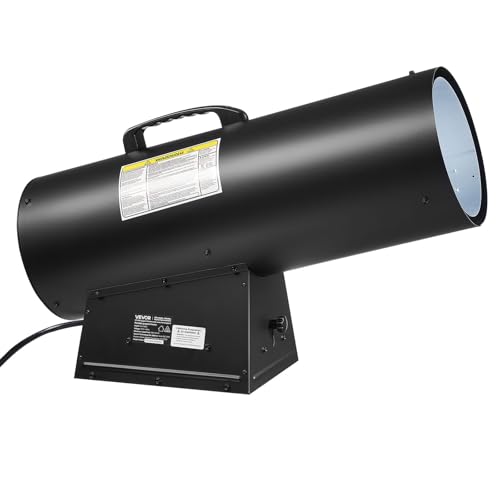
Best for very large spaces and high-altitude environments. This model delivers up to 125,000 BTU with stepless temperature settings and a wide heat spread, capable of warming up to 3,100 sq ft. It includes dual safety systems (overheat and flameout protections) and a carbon steel body suited for outdoor use. It supports high-altitude operation up to 4,921 ft. Choose this if you need maximum heat output and winter reliability in challenging conditions. Limitation: its size and weight are greater, which may affect portability.
Flame King 60,000 BTU Portable Propane Heater

Best for open, well-ventilated outdoor areas or large garages. This Flame King unit provides 60,000 BTU with forced air for efficient warmth. It includes built-in safety features such as a fuel shutoff, fire detection, and tilt shutoff. It has automatic ignition and gas control for straightforward operation. Choose this option for reliable outdoor heating in patios, covered spaces, or garages up to 1,500 sq ft. Caution: proper ventilation is essential to prevent gas buildup in confined spaces.
Mr Heater 125,000 BTU Forced Air Heater

Best for very large spaces like workshops and warehouses needing robust heat. This model delivers 125,000 BTU with a 10 ft hose and regulator included, supporting larger area coverage. The high-output unit is suited for professional setups where steady, intense heat is needed. It is less ideal for compact spaces due to its size and fuel consumption. Consider this if you require sustained heat for big work zones.
DEWALT 68,000 BTU Propane Heater

Best for construction crews needing a trusted industrial option. The DEWALT unit delivers 68,000 BTU and is designed for demanding job sites and open spaces up to about 1,700 sq ft. It emphasizes reliability and brand backing. Suitable for daytime use on job sites where safety and consistent performance are priorities. Limitation: heat output is mid-range compared with the 125,000 BTU models, so it may require more time to heat very large spaces.
Buying Guide
What should you consider when choosing a fan-forced propane heater?
- Space size and target area: For up to 1,500 sq ft, 60,000 BTU units are usually adequate; for larger spaces, consider 100,000+ BTU models.
- Portability vs. permanence: Heavier, higher-output models are less portable but better for fixed job sites.
- Ventilation and safety: Ensure proper ventilation in enclosed areas. Look for features like tilt shutoff, flame-out protection, and high-temperature limits.
- Power source compatibility: Most models run on liquid propane tanks; check regulator compatibility and altitude specifications if you are in mountainous areas.
- Durability and construction: Steel or carbon steel bodies withstand job-site conditions; consider weatherproofing for outdoor use.
- Maintenance and fuel management: Understand maintenance needs and how easy it is to source fuel and spare parts.
Frequently Asked Questions
- What size heater do I need for a 1,500 sq ft space?
Typically a 60,000 BTU to 125,000 BTU unit is appropriate depending on insulation and ceiling height. Larger spaces may require higher outputs or multiple heaters.
- Are propane heaters safe for open garages?
Yes, with proper ventilation and following safety features like flame-out protection and shut-offs. Never operate in fully enclosed, unventilated spaces.
- Do high-altitude models matter for me?
Yes. Some models include regulators suitable for high-altitude use, which helps maintaining stable flame and heat output.
- Is portability important if I move between sites?
If you need frequent relocation, prefer lighter units with wheels or handles, and models rated around 60,000 BTU to 75,000 BTU for easier transport.
- What safety features should I look for?
Thermocouple safety, high-limit shut-off, flame-out protection, tilt shutoff, and automatic ignition controls are common and important for safer operation.
- Can I use these heaters indoors?
Most fan-forced propane heaters are designed for ventilated spaces or well-ventilated interiors. Always follow manufacturer guidelines and local codes.