Discover top fireplace fans and blowers designed to improve heat circulation and reduce cold spots. This guide highlights five reliable options suited for different fireplace setups, from gas inserts to wood stoves. Ideal buyers include homeowners seeking quieter operation, installers needing universal compatibility, and those aiming to boost radiant heat without upgrading their entire system. The table below provides quick reference to each chosen product.
| Product | Main Benefit | |
|---|---|---|
| Replacement Fireplace Blower Kit (Adviace Store) | Replace worn blower with magnetically controlled thermostat and rheostat | Gas or gas-log fireplace inserts needing easy upgrade |
| GFK-160A Fireplace Blower Kit (Hiorucet Store) | Higher airflow with 160 CFM and universal compatibility | Multiple-brand inserts requiring stronger circulation |
| JossaColar Wood Stove Fan | Heat-powered, no electricity needed; includes thermometer | Wood stoves and non-electric setups |
| VODA Wood Stove Fan | Heat-activated with durable aluminum blade | Wood-burning stoves and fireplaces needing silent operation |
| 9733 Small Centrifugal Blower | Compact centrifugal design with variable controller | Camp, grill, and small heating projects |
Replacement Fireplace Blower Kit For Gas Fireplaces

This kit offers a replacement blower with a magnetically mounted thermostat and a rheostat speed control, plus a three-prong power cord and pre-wired harness. It is designed to fit common Heatilator and related models, reducing noise with included double-stick foam pads. Best for homeowners updating a gas insert who want easier installation and quieter operation.
Why chosen: It aligns with common retrofit needs, includes essential mounting accessories, and provides adjustable speed control for customized heat circulation. Limitations: Verify compatibility with your exact model before purchasing, as reference numbers vary by insert.
GFK-160A Fireplace Blower Kit

The GFK-160A kit is designed for broader compatibility across Heat N Glo, Quadra-Fire, Heatilator, and Superior models. It features two blowers with a total air discharge length of about 4.75 inches per unit, a Class H insulation rating, and a 3-prong, 83-inch power cord. Best for: installations needing higher airflow for stronger heat distribution and universal fit.
Why chosen: The larger airflow (160 CFM per the spec) offers better warmth spread in rooms with larger footprints. Caution: Check mounting space and existing wiring harness compatibility before purchase.
JossaColar Wood Stove Fan

This heat-powered wood stove fan requires no electricity and includes a magnetic thermometer. It uses an upgraded aluminum blade designed to distribute heat more evenly. Best for: wood-burning stoves and fireplaces where electrical outlets are limited or undesired.
Why chosen: It provides silent operation through passive heat activation and includes a thermometer to help monitor stove temperatures. Limitation: Effectiveness depends on stove surface temperature and ambient heat levels.
VODA Wood Stove Fan
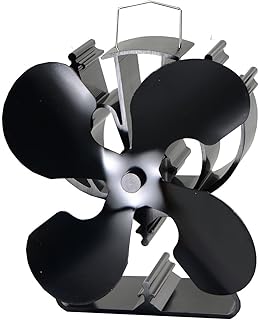
VODA’s heat-activated design eliminates the need for electricity. It features a durable aluminum blade and a magnetic thermometer to help monitor heat levels. Best for: quiet operation and simple setup with wood stoves or fireplaces where power access is limited.
Why chosen: Provides reliable passive heating distribution with a compact form. Caution: Performance depends on stove surface temperature and room heat; may require stronger heat sources for larger spaces.
9733 Centrifugal Blower

Compact centrifugal blower with a variable controller, useful for camping, grills, small stoves, and DIY projects. Best for: portable or small heating projects where space is at a premium and precise control is needed.
Why chosen: Versatile in low-profile setups and compatible with a variety of small heaters. Caution: Not intended to replace large built-in fireplace blowers in big rooms.
Buying Guide
What should you consider when choosing a fireplace blower?
- Compatibility: Check model cross references and mounting space for universal fit.
- Airflow (CFM): Higher CFM provides stronger heat distribution but may be louder.
- Power source: Electrical vs. heat-powered designs affect installation and energy use.
- Noise: Foam mounting pads and insulation reduce vibration and sound transmission.
- Thermostat & speed control: Magnetic thermostats and rheostats enable precise comfort levels.
- Durability: Insulation ratings (Class H) indicate heat tolerance in close-fire environments.
Which option is best for your setup?
- Gas and electric inserts needing retrofit performance: Replacement blower kits with thermostats and rheostats are ideal.
- Wood stoves with no electricity: Heat-powered fans provide silent, maintenance-free operation.
- Small rooms or portable projects: Compact centrifugal blowers fit limited spaces but may offer lower airflow.
Installation and safety tips
- Follow included installation instructions carefully to avoid loose wiring or improper mounting.
- Use provided foam pads to reduce vibration and protect sheet metal from noise amplification.
- Confirm voltage and plug type before connecting power to prevent electrical hazards.
FAQs
- What is CFM and why does it matter? CFM stands for cubic feet per minute and measures airflow; higher CFM means more heat distribution but may increase noise.
- Can I install a universal blower kit myself? Yes, if you have basic wiring and mounting space, but consult a professional if unsure.
- Are heat-powered fans safe for wood stoves? They are designed for high temperatures and require proper clearance and airflow around the unit.
- Do these blowers require maintenance? Minimal maintenance is often required; inspect for dust buildup and ensure thermostat and rheostat operate smoothly.
- Will a higher-CFM blower heat a large room faster? It can, but room layout and insulation also affect heat distribution.