Best Gas Water Heater Types for Quick Home Hot Water
When choosing a gas water heater, the primary decision is tankless versus tank-style and how many fixtures you need to run simultaneously. This guide highlights five top natural gas tankless options and discusses who each is best for, along with practical buying tips. Ideal buyers include busy households, larger homes, and anyone seeking on-demand hot water with compact footprint. A quick summary table follows the introduction to help you compare at a glance.
| Product | Type & Capacity | Best For | Key Benefit |
|---|---|---|---|
| APUS Tankless 95,000 BTU | Gas Tankless 4.42 GPM | Smaller homes or two showers + sink | Stable temperature with precise control |
| VEVOR Tankless 100,000 BTU | Gas Tankless 4.3 Gal | Family homes seeking straightforward controls | Large LED display and easy operation |
| Rheem RTG Series | Gas Tankless 7.0 GPM | Homes with multiple bathrooms | High flow, space-saving design |
| MIZUDO Tankless 199,000 BTU | Gas Tankless 10.3 GPM | Large households with 2–3 bathrooms | Very high flow and multi-point use |
| NOVIEEX Tankless 4.3 GPM | Gas Tankless 4.3 GPM | Two to four fixtures | Compact with LED touchscreen |
APUS Natural Gas Tankless Water Heater Overview

Best for mid-sized homes with two showers and a sink running at once. This APUS unit delivers 95,000 BTU and 4.42 GPM, with low-flow start at 0.66 GPM to ensure hot water even under modest demand. Temperature control spans 95°F–140°F, with ±1°F stability. Its copper heat exchangers and segmented combustion support high efficiency and steady comfort during peak usage. Choose this if you want durable performance in a compact, indoor installation.
Limitation: The unit’s performance is optimized for moderate simultaneous usage; very large households may require a higher-capacity model or multiple points of use.
VEVOR Tankless Water Heater Gas Overview
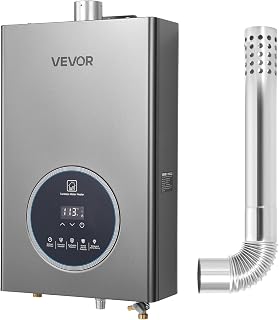
This model suits households seeking a straightforward, reliable whole-house hot water solution. Its 4.3 GPM capacity at 100,000 BTU provides consistent warmth, and the bright LED display with touch controls helps users tailor temperature precisely. The unit is positioned as a practical option for common family needs where simple operation matters most. Best for: moderate-sized homes with standard hot water demands and a user-friendly interface.
Caution: As with many gas tankless models, installation quality affects performance; ensure adequate venting and clearances per local codes.
Rheem RTG Series For Whole-House On-Demand

Best for larger homes or families with 2–3 showers running at once. The Rheem RTG series delivers 160,000 BTU and 7.0 GPM, allowing continuous hot water with a non-condensing design. Its indoor installation and space-saving wall-mount fit compact utility rooms while delivering reliable performance for demanding schedules. Best for: replacing older tanks in multi-bath homes needing robust on-demand output.
Limitation: Non-condensing units can be less efficient than condensing models in extreme climate conditions; consider venting requirements and energy use when evaluating long-term costs.
MIZUDO Natural Gas Tankless — High Flow

Best for very busy households with multiple fixtures and high simultaneous demand. With 199,000 BTU input and up to 10.3 GPM, this unit supports 2–3 bathrooms and beyond, including kitchens and laundry. It offers ±1°F precision and a wide temperature range up to 149°F, making it suitable for deep soaking tubs and substantial domestic use. Pick this if you need maximum flow for large homes.
Limitation: Higher capacity units may require more space and robust venting; verify installation space and gas supply compatibility before purchase.
NOVIEEX Natural Gas Tankless — LED Touchscreen

Best for compact homes needing precise control for 2–4 fixtures. The 4.3 GPM capacity and 95–149°F adjustable range with a digital thermostat deliver reliable on-demand hot water. The LED touchscreen simplifies operation and monitoring, making it suitable for users who value modern interfaces and predictable performance. Choose this if you want a balance of capacity, control, and space efficiency.
Limitation: Like other tankless units, performance can vary with cold-water inlets; ensure proper sizing for your climate and water usage patterns.
Buying Guide: How To Choose The Right Gas Tankless System
Sizing matters most. Start by listing the number of hot water fixtures that typically run at the same time. A higher GPM rating supports more simultaneous outlets. Consider your climate, as colder inlet water reduces effective flow. Location also controls efficiency; indoor units save space but require proper venting and clearances.
Key questions to guide your decision
- How many fixtures need hot water at once?
- What is the peak water temperature you require?
- Is indoor space limited, and do you need a compact unit?
- What is the typical water temperature of your incoming supply?
- Do you prefer a model with a digital display and easy controls?
Comparison tips
- Higher BTU generally means more immediate hot water; match BTU to your home’s demand.
- Flow rate (GPM) indicates simultaneous performance. For 2–3 bathrooms, aim for at least 6–7 GPM total.
- Energy efficiency (UEF) affects long-term costs; condensing models tend to be more efficient, though they may require more venting considerations.
- Installation complexity matters. Indoor, vented units save space but require proper vent configuration.
- Maintenance should be considered — copper heat exchangers typically offer durability and efficiency.
What to expect during installation
Professional installation ensures proper venting, gas supply, and electrical connections. Tankless systems require proper gas line sizing and venting to maximize performance and safety. Always follow local codes and use recommended clearances.
Frequently Asked Questions
- What is the advantage of a tankless gas water heater? It provides on-demand hot water with no storage tank, reducing standby heat loss and saving space in smaller living areas.
- How do I choose the right GPM for my home? Add the number of fixtures you want to run simultaneously and select a unit that meets or exceeds that total GPM, considering typical water temperature rise in your climate.
- Is a higher BTU rating always better? Not always. It should match your demand and venting capability; oversizing can waste energy and increase installation cost.
- Do tankless heaters require more maintenance? They may require periodic descaling in hard water areas and regular vent inspection just like other gas appliances.
- Can I install a tankless heater indoors? Yes, many models are designed for indoor use, but ensure proper venting, clearance, and electrical/gas connections per the manufacturer’s instructions.
- Which model is best for a large family? Look for higher GPM (6–7+), extensive hot water demand support, and robust venting and installation options; models like the MIZUDO and Rheem RTG lines fit larger homes.