When choosing a heater for a grow tent, prioritize precise temperature and humidity control, safety features, and energy efficiency. The right unit keeps young plants in the ideal growth range while preventing heat spikes that can stress or burn them. The following five options are well-suited for most grow tents and small greenhouses, each tailored to different grower needs—from smart, sensor-driven control to multi-zone climate management. This buyer-friendly guide highlights who each product is best for and why it stands out.
| Product | Best For | Key Benefit | Limitations |
|---|---|---|---|
| VIVOSUN AeroFlux 700W PTC Grow Tent Heater | Smart control enthusiasts; larger tents | 40% stronger heat with 5 levels and app/VPD control | Higher power may be overkill for very small tents |
| AC Infinity THERMOFORGE T3, 530W | Precise, programmable climate | Onboard controller with VPD triggers and 10 PWM levels | Setup complexity for new users |
| VEVOR Greenhouse Heater, 1500W | Humid, large grow spaces | Fast 5100 BTU heating; versatile use | Higher wattage consumes more energy |
| Spider Farmer Heater, 530W | Even, stable temp with adjustable zones | 10 levels for heat and fan; dead-zone regulation | Requires careful setup for best zone control |
| AC Infinity TERRAFORM 8 | Integrated climate control in tight spaces | All-in-one A/C with auto cool/heat and AI regulation | ducting may require additional setup |
Note: The table above helps compare core strengths and potential limitations. Each product is chosen to illustrate different approaches to grow-tent heating, from smart, sensor-driven systems to more traditional, powerful heaters. Use the table to quickly align your tent size, energy preferences, and desired control methods.
VIVOSUN AeroFlux 700W PTC Grow Tent Heater

Key features include 700W heating power, 40% stronger output than standard models, and five adjustable heat levels. It also offers smart temperature control with a real-time sensor that tracks temperature and VPD, automatically adjusting heat output to support plant transpiration. The unit targets grow tents and other compact spaces, providing steady warmth to maintain an ideal microclimate. This product is best for growers who want precise control via smart features and a robust heat output for mid-sized spaces.
Best for: Growers needing stronger, consistent heat with smart adjustments. Why selected: Combines a high heat output with real-time VPD-based control, which helps optimize plant growth. Caution: The unit’s higher power draw may be unnecessary for very small tents or very warm climates.
AC Infinity THERMOFORGE T3, 530W

The THERMOFORGE T3 emphasizes precision with built-in onboard control, a corded sensor probe, and VPD-ready triggers. It offers 10 distinct heat levels via PWM, enabling fine-tuned temperature control to suit different growth stages. Timers and cycles add automation for stable environments. This option is best for growers who want granular temperature management with a dedicated control system that integrates with tent setups.
Best for: Growers who prioritize fine-grained temperature control and automation. Why selected: Advanced PWM-based heating with VPD-aware triggers provides stable conditions across growth stages. Caution: Some users may find initial setup and calibration more involved.
VEVOR Greenhouse Heater, 1500W

Powered by 1500W PTC heating, this model delivers rapid warmth with a 5100 BTU output. It includes overheat protection and IP20-rated construction for humid environments, making it suited for greenhouses, grow tents, or plant rooms with higher humidity. It is best for larger spaces or when faster warming is required. Caution: Greater wattage tends to increase energy use, so pair with thermostat control to optimize efficiency.
Best for: Larger tents or humid environments needing quick warmth. Why selected: High heating capacity paired with safety features and durable materials. Limitation: Higher energy consumption without proper temperature management.
Spider Farmer Heater, 530W
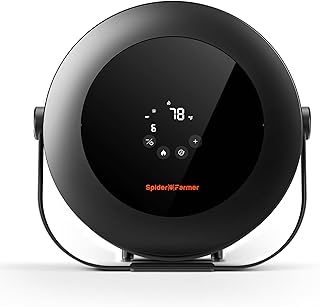
This heater uses 530W with 10 adjustable levels for heat and fan speed, and a temperature-regulation design that minimizes on/off cycling through dead zones. Built-in sensor continuously monitors the space to adapt heating and ventilation, helping maintain stable conditions year-round. It’s a strong pick for growers who want a balance of power and nuanced control across temperature and airflow. Caution: Zone-based regulation requires thoughtful placement to ensure even heating in the tent.
Best for: Growers seeking stable temperature with customizable heat and airflow. Why selected: Dead-zone regulation reduces temperature swings, supporting steady plant growth. Limitation: Zone design may need careful placement for uniform coverage.
AC Infinity TERRAFORM 8, 5-in-1 Plant Air Conditioner

The TERRAFORM 8 offers an all-in-one climate solution with dynamic AI self-regulation. It connects to a single duct for cooling, heating, or air exchange and supports dry-down with manual two-duct adjustments. Set a target temperature or VPD, and the system automatically toggles between cool, heat, and fan to maintain the desired climate. This is ideal for growers seeking integrated climate control in compact spaces. Caution: Ducting setup can be more involved than standalone heaters.
Best for: Growers wanting an integrated, single-duct climate control system. Why selected: Automated, AI-assisted adjustments simplify maintaining stable conditions. Limitation: May require additional ducting or installation work to maximize performance.
Buying Guide: Key Considerations For Selecting A Grow Tent Heater
- Space and tent size: Choose wattage and heat output appropriate for your tent volume to avoid overheating or underheating.
- Control method: Decide between manual controls, smart sensors, or all-in-one climate systems based on how hands-on you want to be.
- VPD and humidity management: If plant transpiration is a priority, select models offering VPD-aware control or precise humidity management.
- Safety features: Look for overheat protection, tip-over shutoff, and ETL or similar certifications for safe operation in humid environments.
- Energy efficiency: PWM or multi-level heat settings can improve efficiency and reduce energy use over time.
- Expansion potential: Consider whether you might expand to larger tents or add ducting for airflow and ventilation.
- Noise and placement: Some units operate quietly, while others are louder; plan placement away from plant canopies if noise is a concern.
FAQ
- What is VPD and why does it matter for tent heaters? VPD (Vapor Pressure Deficit) relates to plant transpiration and growth. Heaters with VPD-aware controls help maintain optimal moisture and temperature balance for healthier plants.
- Is a higher wattage heater always better for tents? Not always. Larger tents or humid environments benefit from more heat, but oversizing can waste energy and raise risks if not properly controlled.
- Should I use a single heater for multiple tents? It depends on spacing and heat requirements. Dedicated heaters for each tent simplify precise climate management.
- Do these heaters require professional installation? Most are plug-and-play with simple ducting or placement, but some integrated systems may need more setup.
- What safety features are essential? Overheat protection, tip-over shutoff, and proper electrical certifications are important for safety in grow environments.
- Can these units help with humidity control as well? Some models pair heat with fans or ventilation, but dedicated humidity control tools may be needed for precise RH management.