Automated gutter de-icing cables help prevent ice dams, protect roof integrity, and keep water flowing in freezing weather. This guide compares five popular options, highlighting who each product is best for, along with practical buying considerations. Ideal for homeowners, contractors, and property managers seeking reliable winter protection without guesswork.
HEATIT HIRD 60 Ft 5 W/Ft Roof & Gutter Cable

The HEATIT HIRD 60 ft cable offers a constant wattage design with 5 watts per foot and a 6-foot pre-installed cold lead with plug. It features full ETL and CSA safety certifications, with UL certification for the plug. The construction uses XLPE inner insulation and a weather-resistant PVC jacket, plus an aluminum foil and tinned copper braid for durability. Best for: typical residential gutters and downspouts where safety certifications and long-life components matter most. Caution: ensure proper mounting and use of included clips and spacers to avoid loose sections in high wind or heavy snow.
HEATIT HIRD 30 Ft 5 W/Ft Roof & Gutter Cable
This 30-foot version mirrors the safety and build quality of the 60-foot model with the same comprehensive certifications and pre-assembled 6-foot lead. It is well suited for smaller homes, shorter gutters, or tighter rooflines. Best for: smaller properties or retrofit projects where a shorter run fits the gutter footprint. Caution: shorter length may require multiple runs for larger roof spans.
Easy Heat ADKS-500 100′ Roof/Gutter Kit
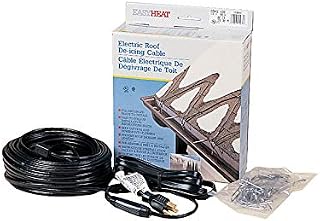
The ADKS-500 kit provides a complete installation package, including roof heat cable, shingle clips, spacers, a user manual, and labeling for breaker and on/off switch. It aims to simplify installation and is designed to prevent ice dam formation by maintaining water flow in gutters and downspouts. Best for: DIY installers who want a full kit with mounting hardware and clear setup instructions. Caution: includes a one-year limited warranty; verify compatibility with your roof type and gutter configuration.
3FT Heat Tape For Water Pipes, -40°F Deicing Cable

This 3-foot heat tape is rated for extreme cold, advertising -40°F capability and a high-temperature efficiency with an 18 W/ft design. It is built with a thicker copper core for improved heating and energy efficiency. Best for: targeted pipe de-icing or small sections of gutter systems where higher heat output is beneficial. Caution: longer runs may require additional protection and hardware not included in this shorter kit.
H&G Lifestyles 8W/ft Roof Cable, 140Ft

H&G Lifestyles offers an 8W/ft self-regulating roof heat cable with a long 140-foot length. Self-regulating technology adjusts power output based on temperature, maintaining effective melting performance with a maximum near 158°F. Best for: homes in very cold climates where consistent melt and energy efficiency are priorities. Caution: self-regulating cables can be more expensive; ensure the installed length aligns with gutter and downspout coverage to avoid gaps.
Buying Guide
- What heat output do I need? Fixed-wattage cables provide a constant power level, while self-regulating cables adjust output with temperature. For large roofs or variable winter conditions, higher or self-regulating options often perform better.
- What length should I choose? Measure gutter and downspout runs. Longer systems reduce dead zones but may cost more. For typical homes, 60–100 feet covers common spans; consider extra length for complex rooflines.
- What safety certifications matter? Look for ETL and CSA certifications on the cable and UL certification on the plug. These indicate adherence to safety standards in North America.
- How easy is installation? Kits with mounting clips, spacers, and clear instructions simplify setup. DIY-friendly options may include labeled breakers and on/off switch guidance.
- Best for what scenarios? Colors of use vary: residential gutters, downspouts, and roof eaves each have different thermal needs. Self-regulating cables excel where temperatures fluctuate, while fixed-power cables work where heat loads are predictable.
- What about durability? Inner insulation (like XLPE) and weather-resistant jackets protect against moisture, UV, and freezing temperatures. Look for sturdy braids and robust outer jackets for longevity.
Quick Product Comparison
| Product | Length | Power | Best For | Notes |
|---|---|---|---|---|
| HEATIT HIRD 60 Ft | 60 ft | 5 W/ft | Medium to large gutters | Comprehensive certifications |
| HEATIT HIRD 30 Ft | 30 ft | 5 W/ft | Smaller homes | Same safety features, shorter run |
| Easy Heat ADKS-500 | 100 ft | Fixed power kit | DIY installations | Complete kit included |
| SZFY 3FT Heat Tape | 3 ft | Includes 18 W/ft variant | Small pipe sections | Extreme cold rating |
| H&G 8W/ft 140Ft | 140 ft | 8 W/ft (self-regulating) | Very cold climates | Self-regulating, longer length |
FAQ
- Do I need self-regulating or fixed-wattage cable? Self-regulating cables adjust to temperature, saving energy in milder cold and providing full heat in deeper freezes. Fixed-wattage cables provide consistent heat but may use more energy in milder temperatures.
- Can I install these myself? Many kits are designed for DIY installation with clips, spacers, and clear manuals. Ensure you follow local electrical codes and use appropriate outdoor-rated equipment.
- Is safety certification required? Yes. Look for ETL and CSA certifications on the cable and UL certification on the plug to ensure compliance with safety standards.
- How long should the cable last? High-quality cables with robust insulation and jackets typically offer several winter seasons of use, depending on climate and installation quality.
- What maintenance is needed? Generally none beyond periodic inspection to verify clips remain secure and there are no signs of wear or damage after heavy storms.
- What if water still freezes? Recheck the length coverage and confirm there are no gaps at joints or fittings. In some cases, adding extra length or additional clips can improve performance.