Best Hot Water Air Vent Solutions for Hydronic Heating Systems
Answering the common question, these vents remove trapped air from hot water heating and hydronic systems to improve circulation and efficiency. This guide highlights practical options for homeowners, technicians, and do‑it‑yourself renovators who need reliable automatic or manual air vents. Choose based on connection size, material, and maintenance needs. The products below are selected for compatibility with hot water radiators, baseboards, convectors, and boilers, and are grouped to help you compare installation and performance quickly.
| Product | Best For |
|---|---|
| Taco 400-4 Hy-Vent | Residential hot water radiators and baseboards |
| Bzcovac 400-4 NPT Vent | High-temperature systems with easy serviceability |
| E.H.C. Chrome Coin Key 1/8″ Vent | Manual air bleeding with coin-key operation |
| Sunluway Automatic Float Valve | Broad compatibility, easy replacement |
| Zymurgoes 400-4 Hy-Vent | Compact, tight-spaces installation |
These selections emphasize robust brass construction, corrosion resistance, and clear maintenance options. Each entry includes best-use notes and potential limitations to help you pick the right vent for your system.
Taco 400-4 1/8-Inch-NPT Float Air Hy-Vent

Material and design: Sturdy brass construction suited for hot water radiators, baseboards, convectors, radiant panels, and small unit heaters. Maximum working pressure is 150 psi. The vent opens for cleaning since the top is threaded. Best for: homeowners with traditional hot water radiators who want a durable, serviceable vent. Limitation: not as compact as some modern, space-saving designs, so installation room matters. Rationale: brass and threaded top cap enable long service life and straightforward maintenance.
Bzcovac 400-4 1/8-Inch NPT Automatic Float Air Vent Valve

Key features: Durable brass construction with corrosion-resistant finish, suitable for up to 150 psi and 240°F. It provides automatic high-capacity air release to improve circulation and reduce noise. The serviceable top cap allows easy cleaning without replacing the unit. Best for: systems that demand reliable, maintenance-friendly venting in tight spaces or higher-pressure hot water lines. Limitation: top-cap design may require periodic cleaning in dusty or debris-prone installations. Rationale: robust materials and serviceability support longer life in demanding hydronic setups.
E.H.C. 1/8″ MIPS Chrome Coin Key Radiator Vent Bleeder Valve (Set of 3)
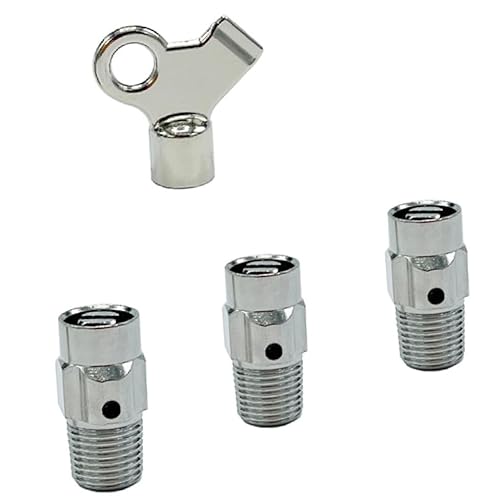
What to know: This set includes three 1/8″ MIPS valves with a coin-key operation for manual air bleeding. Best for: users who prefer manual venting in existing radiator systems or who want quick, on-demand air release. Limitation: manual operation means there is no automatic air removal; you must bleed air manually. Rationale: convenient coin-key design simplifies maintenance and reduces the need for specialized tools.
Bzcovac 400-4 1/8-Inch NPT 4-Pack

Package and purpose: Four automatic high-capacity air vents with brass construction, designed to vent air from hydronic systems reliably. Best for: larger installations or multiple zones where a set of vents simplifies stocking and replacement. Limitation: multiple units may be overkill for a single radiator setup. Rationale: bulk-pack option provides consistent parts across several zones or radiators, improving maintenance efficiency.
Saillong 2 Pack 1/8″ Automatic Air Bleed Vent Valve, Brass

Features: Brass construction with universal 1/8″ male threading, designed for hot water radiators, small unit heaters, and similar systems. Best for: installations needing a compact, automatic vent with straightforward replacement. Limitation: only 2 vents per pack, which may require additional vents for larger systems. Rationale: brass durability and universal thread size support simple, broad compatibility.
KVAEY Brass Automatic Float Valve, 1/2″ MPT Thread

Highlights: Thickened brass construction to resist corrosion and handle high temperatures in hot water radiators and baseboard systems. Best for: systems needing a robust, long-lived vent with a larger connection size. Limitation: 1/2″ MPT connection may not fit every radiator configuration without adapters. Rationale: designed for demanding environments where reliability and reduced maintenance are priorities.
Buying Guide: Key Considerations for Hot Water Air Vents
- Connection size and thread type: Match 1/8″ NPT or 1/8″ MIPS (as many listed) to your radiators or piping. Consider adapters if needed.
- Material and durability: Brass vents resist corrosion and high temperature, facilitating longer service life in hydronic systems.
- Automatic vs manual venting: Automatic vents work continuously to remove air; manual vents require user operation but can be simpler and cheaper.
- Pressure and temperature ratings: Aim for vents rated for up to 150 psi and temperatures around 240°F to handle typical hot water systems.
- Maintenance and accessibility: Top-cap vents that are serviceable are easier to clean without replacing the unit; consider how easy it is to access vents in your installation.
- System size and configuration: For multi‑zone or multi-radiator setups, consider a mix of vents or packs to cover all zones efficiently.
Frequently Asked Questions
- What is the main purpose of a hot water air vent?
To automatically release trapped air from hydronic heating systems, improving water flow and heating efficiency. - When should I choose an automatic vent over a manual one?
If you want continuous air removal and less hands-on maintenance, choose an automatic vent. - Can vents overheat a system if rated for high temperature?
Properly rated vents prevent overheating; mismatches in capacity or oversized vents don’t automatically benefit the system and may waste energy. - Are brass vents better than plastic ones?
Brass vents generally offer greater durability and temperature resistance in hydronic applications. - Do I need an installer for hot water air vents?
A straightforward job for many DIYers, but professional installation ensures correct sizing and leak-free connections in complex systems. - How many vents should a typical boiler room have?
The number depends on system size and number of zones; for multiple radiators, one vent per zone is common to maintain even circulation.