Answering your need for reliable inline heat duct fans: these models are designed to move air efficiently, reduce heat buildup, and improve air quality in spaces like basements, attics, grow tents, and bathrooms. This guide highlights five top options, who they’re best for, and practical considerations to help you pick the right size, noise level, and power. Ideal buyers include DIY homeowners, small greenhouse operators, and workshop users seeking quiet, energy-efficient ventilation.
Summary table of selected products:
- VIVOSUN 6 Inch Inline Duct Fan — 240 CFM — Best for compact spaces with quiet operation
- VIVOSUN 6″ Inline Exhaust Fan & Speed Controller — 345 CFM — Best for stronger ventilation in grow tents
- Hon&Guan 6 Inch Inline Booster — 345 CFM — Best value with low power
- AC Infinity CLOUDLINE PRO S6 — EC motor with 10-speed controller — Best for programmable setups
- VIVOSUN 8 Inch Inline Duct Fan — 420 CFM — Best for larger rooms or higher airflow needs
VIVOSUN 6 Inch Inline Duct Fan 240 CFM

Best for small basements, bathrooms, or attics where space is limited. This fan is constructed from reinforced metal for durability and includes a permanently lubricated bearing that reduces maintenance while keeping noise low. At 6 inches in diameter and 2960 RPM, it delivers 240 CFM with a quiet, under 37 dB operation. Choose this when you need dependable airflow in tight spaces and want a straightforward, low-profile installation.
Who it’s for: DIY homeowners needing a compact, quiet boost to bathroom or attic ventilation. Why selected: balance of solid airflow, compact size, and minimal maintenance.
Limitations: May be underpowered for larger grow tents or high-demand applications where more airflow is needed.
VIVOSUN 6″ Inline Exhaust Fan & Speed Controller

Best for grow tents, greenhouses, and basements needing stronger airflow. Delivers up to 345 CFM with an upgraded EC motor for efficient performance and lower energy use. Noise is kept at a quiet 32 dB(A), making it suitable for spaces where concentration or relaxation matters. The speed controller helps tailor airflow to changing conditions.
Who it’s for: Enthusiasts and small-scale growers who require higher airflow without a big noise footprint. Why selected: higher CFM with energy-efficient EC motor and adjustable control.
Caution: When used in very large spaces, verify that 345 CFM meets the specific ventilation target; you may need multiple units for uniform coverage.
Hon&Guan 6 Inch Inline Booster With Speed Controller

Best for quiet, energy-conscious ventilation in grow rooms, bathrooms, and basements. This booster fan produces 345 CFM with a compact 6-inch diameter and a power draw around 19.2W. It uses a DC motor design to promote efficient airflow with low noise and good reliability. The unit is designed for easy removal and maintenance.
Who it’s for: Budget-minded buyers who want strong airflow with low energy use. Why selected: low power draw and straightforward installation.
Limitations: The plastic blade and housing mean it may not be as durable in harsh environments as metal-bodied models over the long term.
AC Infinity CLOUDLINE PRO S6

Best for programmable ventilation in grow tents, heating/cooling transfer, and equipment racks. This model uses a PWM-controlled EC motor for quiet, energy-efficient performance with minimal heat. It includes a wired 10-speed controller and is compatible with UIS controllers for smart programming. It suits users who want precise control over airflow along a multi-zone setup.
Who it’s for: Growers and professionals needing programmable, scalable ventilation. Why selected: advanced motor control and controller integration for fine-tuned environments.
Caution: The setup is more complex than basic plug-and-play units; ensure you have the space and wiring capability for the controller system.
VIVOSUN 8 Inch Inline Duct Fan 420 CFM
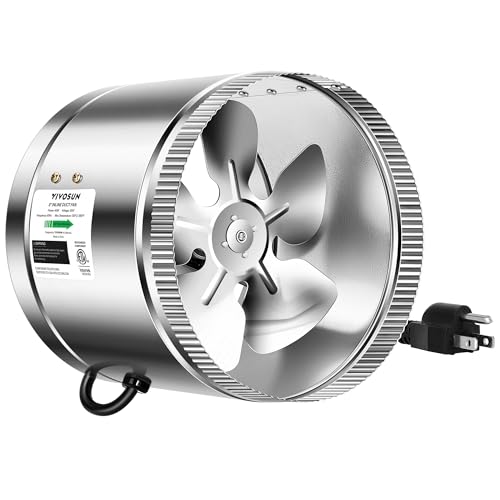
Best for larger rooms, attics, or basements that demand higher airflow. The 8-inch diameter and 420 CFM capacity pair with a durable reinforced metal body and a permanently lubricated motor for quiet operation under heavy use. With a specified noise level under 40 dB, it remains workable in residential environments while delivering robust air movement.
Who it’s for: Property owners or workshop users needing strong ventilation across bigger spaces. Why selected: highest airflow among the listed options, with durable construction.
Caution: Higher airflow comes with increased physical size and sound potential; ensure you have room for installation and an appropriate mounting strategy.
Buying Guide
What size inline duct fan do I need? Start with the target space volume (cubic feet) and desired air changes per hour (ACH). A common rule is 1-2 air changes per minute for bathrooms and basements, and 2-3 for grow tents. Use CFM as your primary metric, matching it to space and ongoing heat load.
How quiet should my fan be? Noise is measured in decibels (dB). For living spaces, aim for under 40 dB. If the environment must stay quiet, prioritize EC motors and units marketed as low-noise or with speed control.
Should I choose a self-contained speed controller or a programmable controller? For simple setups, a built-in speed controller is enough. For multi-zone or automated environments (temperature, humidity), a programmable controller (like the Cloudline Pro) offers precise control and scalability.
Is metal construction better than plastic? Metal fans tend to be more durable in harsh or high-heat environments. Plastic models can be lighter and less expensive, performing well in typical basements and grow tents but potentially less durable over long-term use.
What about energy efficiency? Look for EC motors or DC motors with high efficiency. They offer reduced energy use, quieter operation, and longer service life, especially useful for continuous or long-term ventilation tasks.
Installation considerations: ensure duct compatibility (diameter, length, and bends), proper mounting to minimize vibration, and appropriate electrical supply. Check for maintenance access and cleanable components where possible.
Frequently Asked Questions
- What is the most common duct size for inline fans?
Answer: 4, 6, and 8 inches are the most common, with 6 and 8 inches chosen for higher airflow and larger spaces. - Do inline fans require special wiring?
Answer: Some models with EC motors or speed controllers require basic electrical wiring; follow the manufacturer’s instructions or hire a professional if unsure. - Are inline duct fans suitable for bathrooms?
Answer: Yes, particularly models optimized for low noise and moisture resistance. Verify IP ratings and corrosion resistance. - Can I install multiple fans in parallel?
Answer: Yes, for higher airflow or redundancy, but ensure electrical supply and duct design accommodate the combined load. - What maintenance is needed?
Answer: Regularly inspect blades, clean dust buildup, and lubricate or replace bearings if required by the model’s guidelines. - Which brand offers the best value?
Answer: Value depends on airflow needs, noise tolerance, and longevity. The listed options balance cost, performance, and durability for common rooms.