Answering the call for reliable, in-wall heating, these options deliver solid, no-fuss warmth without clutter. Ideal for buyers who want built-in comfort, reduced footprint, and simple controls. The top picks range from compact, fast-heating units to WiFi-enabled models that fit standard wall cavities. This guide highlights five balanced choices and explains who each is best for, plus practical buying considerations.
| Product | Best For | Key Benefit |
|---|---|---|
| Besilo Upgraded CSC202TW In Wall Heater | Bathrooms and small-to-medium rooms | Fast heat, very quiet operation |
| Heat Storm 1500W In-Wall Heater with WIFI | Smart homes, flexible scheduling | Remote control and schedules |
| EZ-HEAT 1,500-Watt Utility Space Heater | Garages or workshops | Three heat settings with thermostat |
| 9815WH Electric Wall Heater | Bedrooms and living rooms | Dual voltage, built-in thermostat |
| Heat Storm HS-1500-PHX-WIFI Infrared Heater | Compact spaces needing targeted warmth | WiFi control and space-saving mount |
Besilo CSC202TW In-Wall Heater
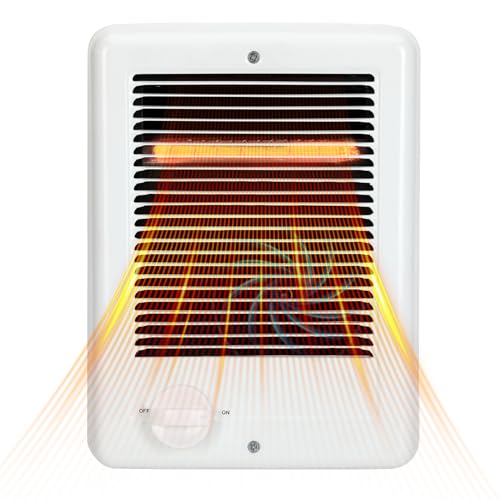
Best for small-to-medium spaces that require rapid warmth. This 2000-watt unit delivers up to 6825 BTU and heats a room quickly, making it ideal for bathrooms, entryways, or home offices. The core provides efficient heat in under two minutes, reducing cold-start discomfort. At a quiet 20 dB, it runs without noticeable distraction. Built-in thermostat-style control allows intuitive adjustments without complex menus, supporting a straightforward daily routine.
Who this is for: buyers who want fast, consistent heat with simple operation. Why selected: high heat output in a compact wall-mounted form, plus very quiet performance. Caution: ensure your electrical supply supports 240V and confirm installation clearances in the chosen space.
Heat Storm 1500 Watt In-Wall Heater With WIFI

Best for tech-forward spaces that benefit from remote control. This model offers built-in WiFi for adjusting heat from anywhere, with selectable 1500W or 750W settings and a digital thermostat with adjustable LED brightness. It suits homes that centralize climate control or users who want quick climate adjustments via a smartphone. Limitation to consider: WiFi dependency means you may rely on network stability for routine heating adjustments.
EZ-HEAT 1,500-Watt Utility Space Heater

Best for budget-conscious spaces like enclosed garages or workrooms. This portable unit offers three heat settings, including a fan-only option, and a rotary thermostat for easy temperature control. While designed for portability and targeted warmth, it is not a built-in in-wall model, so consider whether you need movable heat or a fixed wall installation. Caution: portable use means occasional repositioning if you want even distribution in a larger area.
9815WH Electric Wall Heater

Best for bedrooms and living spaces that need quiet operation and reliable heat. This 1500W unit supports dual voltage (120/240V) and includes a built-in thermostat, with a focus on ultra-quiet performance thanks to a copper motor. It fits standard recessed wall channels and is designed for steady, year-round heating. Limitation: fixed dual-voltage preset may require professional wiring adjustments if your home’s supply is not aligned to the preset configuration.
Heat Storm HS-1500-PHX-WIFI Infrared Wall Heater

Best for compact spaces needing efficient, directional warmth. This infrared wall heater saves space with a wall-mounted design and includes WiFi features for convenient control, a touch screen thermostat, and a remote. The space-saving form makes it attractive for kitchens or study nooks. Caution: infrared heat works best when there are no large obstructions between the unit and occupants; plan placement accordingly.
Buying Guide: Key Considerations For In-Wall Heaters
- Heat output and room size: Match BTU per hour to the room’s square footage and insulation. Higher BTU units heat faster but may require a larger electrical service.
- Voltage compatibility: In-wall heaters commonly run on 120V or 240V. Check your home wiring and available circuit capacity before installation.
- Thermostat type: Built-in, mechanical, or digital thermostats affect ease of use and precision. Consider whether you prefer simple dial controls or programmable schedules.
- Noise level: Quiet operation is essential for bedrooms and offices. Look for units advertised as ultra-quiet or with low dB ratings.
- Installation considerations: Recessed or surface-mounted designs require wall cavity compatibility and potentially professional wiring. Verify clearance, clearance to combustibles, and moisture ratings for bathrooms.
- Smart features: WiFi-enabled models offer remote control and scheduling but rely on network stability. Decide if smart control justifies potential complexity or cost.
- Portability vs. permanence: In-wall models are fixed, while portable options provide flexibility. Choose based on whether you anticipate relocation or remodels.
Frequently Asked Questions
- What size in-wall heater do I need for a bathroom? Answer: Choose a unit with adequate BTU for the room’s size and moisture-rated design, typically a compact 1500W unit for standard bathrooms if well insulated.
- Can I install an in-wall heater myself? Answer: Installation often requires electrical work and adherence to local codes. A licensed professional is recommended for wiring and mounting in-wall units.
- Are in-wall heaters safe for bedrooms? Answer: Yes, when properly installed and maintained. Look for units with overheat protection and quiet operation.
- Do WiFi heated models save energy? Answer: They can help optimize usage through schedules, but actual energy savings depend on settings and room accuracy.
- What maintenance do in-wall heaters require? Answer: Regular inspections for loose connections, clean air vents, and ensuring the thermostat remains accurate.
- Is dual-voltage wiring common for in-wall heaters? Answer: Some models offer dual-voltage support, which can simplify installation in homes with mixed electrical systems.