Procuring the right propane heater for a trailer breaks down into how you’ll use the space, your power access, and safety needs. This guide highlights five dependable models, explaining who they’re best for, and why they fit trailer living or travel scenarios. The top picks cover compact portability, higher BTU outputs, and safety features suitable for garages, campsites, and RV setups. A quick buying table follows to compare core specs at a glance.
| Product | Best For | Approx. BTU | Notes |
|---|---|---|---|
| Ruasveltan 18,000 BTU Indoor/Outdoor Propane Heater | Medium-to-large spaces, no electricity | 6,000–18,000 | Portable with no power needed; great for garages and patios |
| Mr. Heater 30,000 BTU Vent Free Blue Flame | Medium-to-large enclosed spaces | 30,000 | Vent-free; suitable for well-insulated trailers and spaces up to 1,000 sq ft |
| Mr. Heater Big Maxx MHU50NG | Garages and workshops | 50,000 | Ceiling-mounted; compatible with thermostats |
| Mr. Heater MH9BX Portable | Small-to-medium spaces, outdoor use | 4,000–9,000 | Portable, auto shut-off features |
| ProCom ML300HBA-B 30,000 BTU | Large spaces with no electricity | 30,000 | Manual control; oxygen depletion sensor included |
Ruasveltan 18,000 BTU Indoor/Outdoor Propane Heater
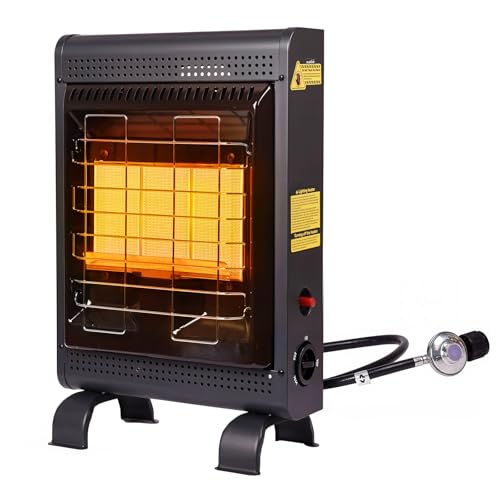
The Ruasveltan unit covers up to 450 square feet with adjustable heat modes (6,000–18,000 BTU). It features piezo ignition for quick starts and a portable, slim design with a wide stand for stability. Best for budget-conscious users who need versatility between indoor and outdoor spaces without relying on electrical power. A potential limitation is that performance can vary with outdoor wind or poor ventilation; ensure proper clearance and use as directed.
Mr. Heater 30,000 BTU Vent Free Blue Flame Propane Heater

This vent-free heater delivers up to 30,000 BTU and heats spaces up to about 1,000 square feet. It’s suited for enclosed trailer spaces that require consistent warmth. Best for customers seeking a higher-output option that operates without electricity. A caveat: vent-free units require adequate ventilation to avoid humidity and indoor air quality concerns; avoid use in poorly ventilated areas for extended periods.
Mr. Heater Big Maxx MHU50NG Natural Gas Unit Heater

This ceiling-mounted unit provides 50,000 BTU, heating up to roughly 1,667 square feet, making it ideal for larger garages or workspaces adjacent to trailers. It’s designed to work with standard thermostats (24-volt or Wi-Fi enabled options sold separately). Choose this for big, tall spaces or when you want a steady, maintenance-friendly heat source. Best avoided in very small trailers where space is constrained and ceiling mounting is impractical.
Mr. Heater MH9BX Massachusetts/Canada Portable

A compact radiant heater offering 4,000–9,000 BTU, suitable for spaces up to 225 square feet. Designed for outdoor and some indoor use, and features auto shut-off for tipping or low oxygen. Best for campers and small trailer interiors where portability matters. Limitation: lower BTU output may be insufficient for larger spaces or very cold environments.
Mr. Heater Portable Buddy Radiant Propane Heater
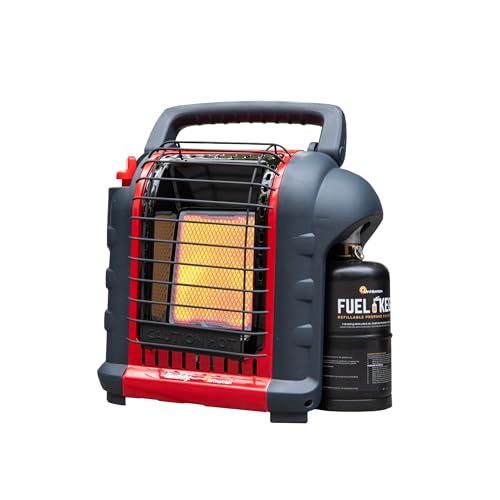
Emitting 4,000 or 9,000 BTU radiant heat, the Portable Buddy is designed and approved for both indoor and outdoor use, cooling down to about 225 square feet of warmth. It’s a flexible option for smaller trailers or camping setups where movement and light weight are priorities. Caution: ensure adequate ventilation in enclosed spaces to avoid buildup of exhaust byproducts, and monitor oxygen levels.
ProCom 30,000 BTU Ventless Liquid Propane Heater

ProCom’s ML300HBA-B offers 30,000 BTU and heats up to 1,400 square feet, with no electricity required. It uses propane and includes a Piezo ignition with three manual heat settings. It also features an Oxygen Depletion Sensor for safety. Best for larger trailers without electrical access. Limitation: ventless operation requires good air circulation and appropriate ventilation to maintain air quality.
Buying Guide
- Space and BTU needs: Larger trailers or garages benefit from higher BTU units (e.g., 30,000–50,000 BTU) while smaller spaces can be comfortable with options around 4,000–9,000 BTU.
- Power source: Consider whether you need electricity-free operation. Vent-free units work well in enclosed spaces but require ventilation. Portable units are ideal for camping and quick setup.
- Ventilation and safety: All ventless or high-output heaters should be used with proper ventilation. Look for Oxygen Depletion Sensor (ODS), auto shut-off on tip-over, and stable mounting options when installing higher BTU models.
- Installation considerations: Ceiling-mounted or wall-mounted units save floor space in garages, while portable models maximize flexibility for trailers and campsites.
- Maintenance and parts: Check for availability of replacement parts, such as thermocouples, regulators, and hoses. A reliable regulator and hose are essential for safe propane operation.
- Weather and altitude: High-altitude or windy environments can affect performance. Some models are designed to adapt to higher altitudes with stable heat output.
Frequently Asked Questions
- Can I use a propane heater inside a trailer? Yes, but ensure proper ventilation and follow safety instructions. Some units are vented, while others require adequate air exchange.
- What safety features should I look for? Look for Oxygen Depletion Sensors, auto shut-off on tip-over, and sealed or vented designs appropriate for indoor use.
- Is a higher BTU heater always better? Not necessarily. Choose BTU based on space size, insulation, and climate. Too much heat in a small, poorly ventilated space can be uncomfortable and unsafe.
- Do these heaters require electricity? Some do not require electricity, while others may use a battery, thermostat, or standard power.
- Can these heaters be used in RVs? Yes, several models are suitable for RV travel, with some designed specifically for RV use or trailers.
- How do I maintain propane efficiency? Use proper regulator and hose fittings, ensure clean pilots, and avoid running at high BTU for extended periods in poorly ventilated spaces.