Looking for a compact, under-sink solution to deliver ready hot water on demand? These sink electric water heaters are designed to fit tight spaces while supplying steady temperature control for kitchens, bathrooms, RVs, and more. This guide highlights five practical options and explains who each is best for, along with simple trade-offs. Whether you need a small booster, a plug-and-play unit, or a compact tank for point-of-use hot water, there’s a model here to fit common layouts and power setups.
| Product | Best For | Capacity | Notes |
|---|---|---|---|
| GE 2.5 Gallon Versatile Mini Tank | Small spaces; booster use | 2.5 gal | Adjustable thermostat; easy to install |
| GE 10 Gallon Versatile Plug & Play | Under-sink or small utility areas | 10 gal | Plug-and-play style; adjustable thermostat |
| 110V Tankless 5000W Under Sink | Compact, on-demand needs | Tankless | Remote control; temperature in C/F |
| 2.5 Gal 1500W Under Sink Mini Tank | Kitchen or bath use; fast heat | 2.5 gal | LED display; stainless steel tank |
| 110V Tankless 3000W Under Sink | Space-saver with digital display | Tankless | ETL listed; compact wall-mount |
GE Appliances 2.5 Gallon Mini Tank With Adjustable Thermostat

- Features compact design ideal for kitchens, bathrooms, laundry rooms, barns, cabins, RVs, garages, sheds, and more.
- Installs in minutes with standard 1/2-in NPT connections; suitable for wall or floor mounting.
- Can function as a standalone unit or booster inline with another heater to handle long pipe runs or washing machines.
Best for: Small spaces where you need a ready supply of hot water without a full-sized heater. It’s a good fit for apartment kitchens, under-sink setups, or remote spaces requiring quick warm-ups. Limitations: 2.5 gallons may not meet higher simultaneous-hot-water demands.
GE Appliances 10 Gallon Plug & Play

- Versatile plug-and-play design for flexible placement.
- Adjustable thermostat for temperature control in small setups.
Best for: Small apartments or under-sink areas needing more hot water than a 2.5-gallon unit but without complex installation. Limitation: 10 gallons may still be limited for multiple fixtures at once.
ETL-Listed Tankless 5000W Under Sink

- On-demand heating with 3000W-5000W variants for tight spaces.
- Digital temperature control and Fahrenheit/Celsius display.
Best for: Quick, space-efficient hot water in small kitchens or baths where you want instant heat without a storage tank. Limitation: Tankless models may require precise electrical wiring and ventilation considerations.
2.5 Gal 1500W Under Sink Mini Tank With LED Display

- 1500W fast heating delivers hot water in about 10 minutes.
- Premium 304 stainless steel construction resists corrosion; includes a relief valve for safety.
Best for: Daily kitchen or bathroom use where quick heat and durable materials matter. Limitation: 2.5 gallons may be limited for multiple simultaneous outlets.
110V Tankless Electric Under Sink, 3000W
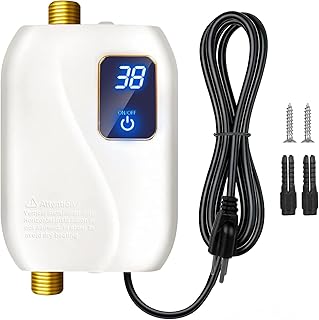
- Tankless operation with 3000W power for faster hot water rise.
- LED digital display and IPX4 waterproofing for safety and visibility.
Best for: Tight spaces where you want robust on-demand performance and a digital readout. Limitation: Tankless require proper electrical capacity and installation clearance.
Buying Guide: Key Considerations For Choosing A Sink Electric Water Heater
- Capacity vs. Demand: Do you need a small booster (2.5–5 gallons) or true tankless on-demand? A larger tank helps with multiple fixtures briefly, while tankless models supply continuous hot water but may require higher electrical capacity.
- Power Requirements: Most under-sink heaters operate on 120V. Tankless models may need higher amperage or dedicated circuits. Check your electrical panel and space for wiring and breakers.
- Installation Space and Mounting: Under-sink heaters should fit your cabinet dimensions and plumbing clearances. Wall-mountable options save cabinet space but may require brackets or studs.
- Material & Durability: Stainless steel tanks resist corrosion and lime buildup better than simple enamel; consider models with protective valves and high-quality insulation.
- Temperature Control: An adjustable thermostat helps tailor hot water to your needs and can improve energy efficiency. LED displays ease monitoring in dim areas.
- Safety Features: Look for temperature relief valves, leak protection, dry-boil protection, and ETL or UL listings for compliance and reliability.
- Energy Efficiency: Insulation quality and heat retention affect standby losses. Smaller tanks can be efficient for point-of-use tasks, while tankless units reduce standby heat loss.
- Maintenance: Corrosion resistance, ease of cleaning, and accessible drain valves (where applicable) simplify upkeep and extend life.
Frequently Asked Questions
- What size under-sink water heater do I need?
Choose by your daily hot-water demand. For one bathroom or kitchen outlet, a 2.5–5 gallon unit often suffices; for multiple fixtures, a 10-gallon model or a tankless system is better.
- Are tankless under-sink heaters safer than tank models?
Both can be safe when installed correctly. Tankless units reduce standby heat loss and provide continuous hot water but require proper electrical wiring and venting considerations.
- Can I install an under-sink water heater myself?
Some plug-and-play or 120V units are straightforward for DIY installation with standard plumbing. More complex or high-wattage tankless models may require a licensed plumber and electrician.
- What maintenance is needed?
Inspect pressure relief valves, check for leaks, and flush tanks periodically if recommended by the manufacturer to prevent mineral buildup.
- Do these work with dishwasher or washing machine hot-water lines?
Yes, some models can be used inline as boosters to supply hot water to appliances with longer pipe runs or higher demand.
- Is there a risk with under-sink heaters in busy kitchens?
High demand can outpace a small tank. If you routinely run multiple appliances, consider a larger tank or a tankless option with higher flow capacity.