For compact living spaces, a tiny home water heater offers reliable hot water without taking up excess room. This guide highlights five suitable options, explaining who each is best for, how they install, and practical tradeoffs. Ideal buyers include apartment dwellers, tiny houses, cabins, RV owners, and anyone needing on-demand or compact hot water solutions.
| Product | Capacity | Best For |
|---|---|---|
| GE 18 Gallon Versatile Plug & Play | 18 gal | Small homes needing flexible, whole-home hot water |
| GE 10 Gallon Versatile Plug & Play | 10 gal | Cavities with limited space; condo or apartment setups |
| Tankless 110V Electric, 3000W | Tankless on-demand | Kitchen or bath under-sink hot water |
| 2.5 Gal Under-Sink 1500W | 2.5 gal | Point-of-use needs; quick hot water at sink |
| VEVOR 18-Gallon Tank | 18 gal | Family use; higher demand with compact footprint |
GE Appliances 18 Gallon Versatile Plug and Play Electric Water Heater

Best for: Tiny homes or small houses needing flexible hot water distribution. This model supplies hot water to a single hookup or an entire small residence, and it installs quickly using standard 3/4-in NPT connections with 120-Volt power. The compact design fits kitchens, bathrooms, or utility spaces in cabins or garages. It’s a strong pick when you want reliable, whole-home hot water without a large unit. Caution: Verify local electrical capacity to ensure 120-volt supply suffices for your full load.
GE Appliances 10 Gallon Versatile Plug and Play Water Heater

Best for: Small apartments, tiny homes, or cabins needing space-saving hot water. This 10-gallon option shares the same plug-and-play appeal as the larger model, with 120-volt operation and standard water connections. It offers flexibility in confined areas like kitchens, bathrooms, or RV storage spaces. It’s a practical choice when you want a balance between size and daily hot-water needs. Caution: It has a lower capacity than the 18-gallon unit, so high simultaneous usage may require planning.
110V Tankless Water Heater Electric, 3000W
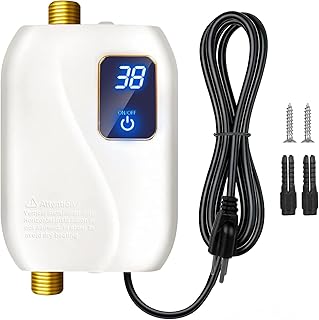
Best for: Point-of-use hot water at a sink or small kitchen/bath area. This 110V tankless unit heats water on demand, eliminating standby energy and delivering hot water quickly. It features an LED display and safety protections, with compact dimensions suitable for under-sink installation. Caution: Tankless units can have limited output at higher flow rates; plan for low-demand scenarios to avoid insufficient hot water.
2.5 Gal 1500W Under-Sink Mini Tank

Best for: Point-of-use needs in kitchens or bathrooms where space is ultra-tight. The 2.5-gallon tank provides hot water quickly via 1500W heating, with a stainless steel interior and a durable enamel-lined tank. It includes a relief valve for safety and a digital LED display showing current water temperature. Caution: Small capacity means frequent re-heating if multiple outlets are used at once.
VEVOR Electric Water Heater, 18 Gallon Tank

Best for: Families or households with moderate hot-water demand in a compact footprint. The 18-gallon tank has an immersion heating element and a rotary temperature control, plus an enamel coating for extra safety. It can deliver hot water across multiple uses while keeping a smaller footprint than full-size tanks. Caution: Ensure proper ventilation and electrical specifications for continuous operation in smaller spaces.
Buying Guide: Key Considerations For Tiny Home Water Heaters
- Capacity vs. Demand: Small homes benefit from 10–18 gallon tanks or tankless options for on-demand needs. Consider daily hot-water usage and whether you need supply to multiple fixtures at once.
- Installation Space: Measure available space to ensure the unit fits in kitchens, bathrooms, basements, or closets. Look for compact or wall-mounted designs for under-sink setups.
- Electrical Requirements: Most plug-and-play models use 120-volt power. Confirm your electrical panel capacity and whether a dedicated circuit is needed.
- Point-of-Use vs Whole-Home: Point-of-use units are ideal at a single sink or shower, while tank-style options suit small homes requiring hot water in several rooms.
- Durability and Materials: Stainless steel interiors resist corrosion and scale; enamel coatings add safety and longevity. Consider units with safety features like dry-boil protection and overheating shutoff.
- Maintenance: Look for accessible drain valves and straightforward flushing requirements to prevent mineral buildup in small tanks.
- Energy Efficiency: Tank-style with proper insulation minimizes standby heat loss. Tankless models reduce standby energy but may have flow-rate constraints.
Frequently Asked Questions
- What size water heater is best for a tiny home? – An 10–18 gallon tank or a compact tankless/point-of-use heater typically fits tiny homes, balancing space and hot-water needs.
- Do I need professional installation for these models? – Some are designed for simple DIY installation with existing plumbing, but check local codes and consider professional help for gas lines, electrical work, or high-load setups.
- Can these heaters supply hot water to multiple fixtures at once? – Tank-style units can supply more than one fixture if capacity is sufficient; tankless units are usually best for single-use hot water at a time.
- Are 120-volt plug-and-play heaters safe for small spaces? – Yes, when installed according to manufacturer instructions and space is ventilated and dry, small 120-volt units are common for tiny homes.
- What maintenance does a small electric water heater require? – Regular flushing to remove mineral buildup, inspecting valves and insulation, and verifying electrical connections help extend life in tight spaces.
- Which feature matters most for under-sink units? – Quick heat-up time, compact footprint, and clear temperature display help manage daily routines efficiently.