Dielectric unions protect water heater systems by separating metals that can corrode when in contact. This article highlights five top dielectric unions, explaining how they work, where they fit in a typical water heater install, and what to look for when choosing. Use these connectors to extend the life of heating equipment and minimize maintenance caused by galvanic corrosion.
Summary of selected products
| Product | Material & Fit | Key Benefit | Typical Use |
|---|---|---|---|
| EZ-Fluid Dielectric Union 3/4″ | Brass solder x FIP; galvanized steel body | Reduces electrolysis; strong dissimilar-metal seal | Copper to steel or galvanized piping |
| Midline Valve EVGG0034-OM Dielectric 3/4″ | Brass x steel; 3/4 in. FIP | Leak-free connections; corrosion reduction | Water heater installations |
| Eastman 20503 Dielectric Union 3/4″ | Brass union with steel nut; silicone/Nylon gasket | Durable, corrosion-resistant transition | Steel to copper transitions |
| Eastman 20505 Dielectric Union 1″ | Brass body; steel IPS nut | Withstands high pressure; copper/steel/copper transitions | Water heater inlet/outlet piping |
| Camco Dielectric Heat Trap Nipples | Dielectric-lined nipples | Prevents heat escape; self-cleaning features | Hydraulic inlet/outlet; flow-stopper scenarios |
Below are five dielectric union options commonly used in residential water heating systems. Each product is evaluated for compatibility, durability, and installation ease to help you pick the right connector for your project.
EZ-Fluid 3/4 Inch Dielectric Union

The EZ-Fluid 3/4 Inch Dielectric Union combines a brass solder connection with a female threaded galvanized steel body. It is designed to connect dissimilar metals, especially copper to steel or galvanized piping systems, while maintaining a watertight seal. Its insulation features help separate metals to prevent galvanic corrosion, making it suitable for water heater applications and other piping connections. Availability ranges from 1/2″ to 2″.
Midline Valve EVGG0034-OM Dielectric Union

This 3/4 in. FIP dielectric union from Midline Valve emphasizes safety by reducing electrolysis between dissimilar metals, thereby lowering corrosion risk and pipe failure. It features brass and steel construction with secure, leak-free connections ideal for water heater systems. The design supports reliable performance under typical residential pressure and temperature ranges.
Eastman 20503 Dielectric Union 3/4″ x 3/4″
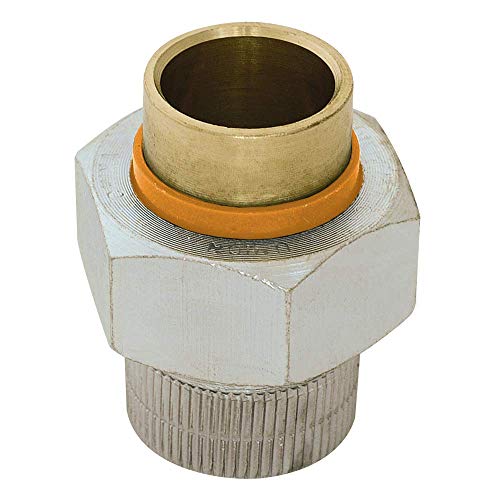
Eastman’s 20503 Dielectric Union uses brass for the main union body and a steel nut. It includes a silicone rubber gasket with a nylon insert, contributing to a robust seal. Rated for up to 250 PSI and 180°F, it is designed to bridge steel and copper piping transitions while minimizing galvanic reactions in the system.
Eastman 20505 Dielectric Union 1″

The Eastman 20505 union is built to minimize corrosion on larger pipelines by using brass for the body and steel for the IPS nut. It supports up to 250 PSI and is rated to 180°F, enabling transitions among steel, brass, and copper piping. Its durability makes it a solid choice for high-usage water heater connections.
Midline Valve EVGG0012-OM Dielectric Union 1/2″
This 1/2 in. FIP dielectric union from Midline Valve emphasizes safety by preventing electrolysis between dissimilar metals. It uses a brass and steel construction with leak-free connections suitable for water heater installations. The compact size makes it a convenient option for tight spaces where a standard 3/4 in. fitting may not fit.
Camco Dielectric Heat Trap Nipples

Camco’s Dielectric Heat Trap Nipples feature a dielectric inert thermoplastic lining to reduce heat loss when flow stops, while self-cleaning fittings help prevent corrosion. They are designed to inhibit galvanic reactions in the inlet and outlet connections, contributing to longer equipment life in water heater systems where heat retention is a priority.
Buying Guide: Key Considerations For Dielectric Unions
- Material compatibility: Match the union’s materials (brass, steel, or galvanized steel) with your existing piping to minimize galvanic corrosion.
- Connection type: Choose between sweat/solder (S x FIP) or threaded (FIP) connections based on installation ease and space constraints.
- Piping sizes: Ensure the union size aligns with your system’s pipe diameter (common sizes include 1/2″, 3/4″, and 1″).
- Pressure and temperature ratings: Confirm the unit can handle system pressures (often up to 250 PSI) and temperatures (up to 180°F) typical of residential water heaters.
- Gasket material and sealing: Gaskets (silicone or other elastomers) and nylon inserts influence longevity and leak resistance.
- Ease of installation: Consider whether you need a compact option for tight spaces or a larger fitting with multiple connection styles.
- Maintenance considerations: Some diaphragms or linings are designed to reduce corrosion over time and may require less frequent inspection.
- Cost vs. durability: While price varies, prioritize units with robust brass bodies and steel nuts for better long-term performance.
Dielectric unions play a crucial role in preventing electrolysis and galvanic corrosion in water heater plumbing. When selecting a unit, balance material compatibility, installation method, and operating conditions to choose a connector that minimizes maintenance and extends the life of the system.