Best Digital Thermostats for Baseboard Heaters: Smart and Traditional Options
Choosing a digital thermostat for baseboard heaters means balancing ease of use, compatibility with high-voltage wiring, and energy savings. Whether you prefer a simple non-programmable model or a feature-rich smart thermostat, there are options that fit 120V and 240V baseboard systems. This guide spotlights five reliable choices, highlighting installation ease, temperature accuracy, and user features. Use the quick comparison table below to compare key attributes at a glance.
| Product | Brand | Type | Voltage | Highlights |
|---|---|---|---|---|
| Honeywell TL7235A1003 Line Volt Pro Non-Programmable Digital Thermostat | Honeywell | Non-Programmable | 240V | Electronic temp control, backlight, quiet operation |
| meross Smart Thermostat For Electric Baseboard | meross | Smart | 120V-240V | Voice assistants, energy saving, easy install |
| Honeywell TL8230A1003 Line Volt Thermostat | Honeywell | Programmable | 240/208V | 7-day programming, precise control, quiet switching |
| Mysa Smart Thermostat LITE | Mysa | Smart | 120V-240V | Wi‑Fi, no subscription, broad integrations |
| Honeywell Home RLV4305A1000 5-2 Day Programmable | Honeywell Home | Programmable | 120V-240V (baseboard-compatible) | 2 daily programs, digital accuracy, quiet operation |
Honeywell TL7235A1003 Line Volt Pro Non-Programmable Digital Thermostat

The Honeywell TL7235A1003 offers a straightforward digital temperature control for 240-volt baseboard and zone heating. It emphasizes reliability with an electronic temperature sensor, backlit display for legibility in various lighting, and a quiet, soundproof operation that reduces the typical thermostat “click.” A clear heating indicator ensures users can confirm when heat is active. This model is well-suited for homes that value simple operation without scheduling, while maintaining precise setpoint control. Compatibility with line-voltage wiring makes it a classic choice for hard-wired baseboard systems.
Meross Smart Thermostat For Electric Baseboard Heaters

The Meross Smart Thermostat is designed for electric baseboard and in-wall heaters, with 120V-240V support and compatibility with Apple HomeKit, Alexa, and Google Home. It advertises an install time of under 30 minutes and supports high-voltage systems with up to 16A (1920W at 120V; 3840W at 240V). The device requires at least four wires in the electrical box for proper operation. It emphasizes smart features such as voice control and energy-saving schedules, offering remote control and integration across major ecosystems. This option is ideal for users wanting a connected, hands-free heating experience.
Mysa Smart Thermostat LITE
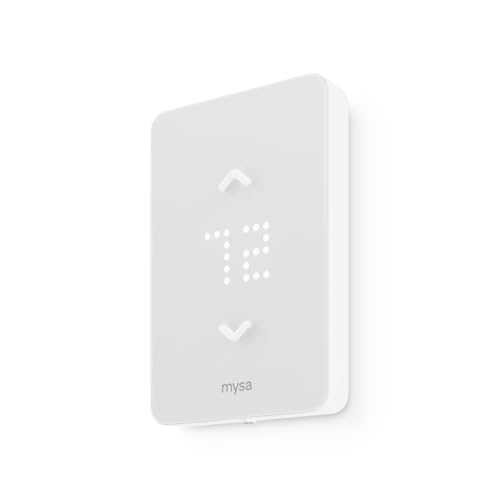
The Mysa Smart Thermostat LITE provides line-voltage control for 120V-240V baseboard heaters and similar appliances. It offers 100% free app features including remote control, scheduling, and energy reports, with no ongoing subscription. The thermostat supports voice integration via HomeKit, Alexa, and Google, enabling voice temperature adjustments. While installation is designed to be DIY-friendly, ensure your wiring matches the device requirements (high-voltage lines and compatible baseboard or convector units). This option blends modern app control with a straightforward setup for convenient, energy-conscious heating management.
Honeywell Home RLV4305A1000 5-2 Day Programmable Thermostat

The Honeywell Home RLV4305A1000 is a 5-2 day programmable model tailored for electric baseboard heaters and convectors. It provides digital temperature control with high accuracy to minimize temperature swings. The product emphasizes silent operation through TRIAC switching and reliable performance across a range of baseboard applications. It suits households seeking a programmable solution to maintain comfort during different daily periods while optimizing energy use. The device targets users who want pre-set heating schedules with dependable temperature stability.
Buying Guide
Key purchase considerations for baseboard heater thermostats include compatibility, voltage, and control style. For line-voltage systems (120V or 240V), verify that the thermostat is designed for your supply. Non-programmable options, like the TL7235A1003, provide simple, reliable control with clear displays and quiet operation, ideal for spaces where schedules aren’t needed. Programmable models, such as the TL8230A1003 and RLV4305A1000, offer daily or weekly scheduling, which helps reduce energy usage by aligning heat with occupancy. Smart thermostats from Meross and Mysa introduce remote access and integrations, enabling energy monitoring and voice control.
Installation considerations include wiring requirements (some smart thermostats require at least four wires), compatibility with existing baseboard configurations (convector, fan-forced, or in-wall heaters), and the importance of a backlit or high-contrast display for easy reading in dim areas. Temperature precision matters for baseboard systems, where a small delta can prevent temperature swings and improve comfort. Some models emphasize silent switching to avoid noisy mechanical relays, which can contribute to a calmer home environment.
Energy-saving strategies extend beyond the thermostat itself. Pairing a programmable or smart thermostat with proper insulation, sealing of drafts, and zoning can optimize heat distribution. For homes with multiple baseboard zones, selecting thermostats that support multi-stage or zone-control capabilities may deliver the best comfort and efficiency. Finally, consider ecosystem preferences; if you already use HomeKit, Google Home, or Alexa routines, a compatible smart thermostat can streamline your heating control and automation.