Best Heat Tape for Sewer Pipes: Prevent Freezing and Bursts
Winter can threaten sewer and drainage pipes with ice buildup and bursts. This guide highlights top heat tape options designed to keep water flowing in metal and plastic sewer lines, preventing costly freezes. Each product below offers different lengths, certifications, and installation features to fit residential and commercial needs.
The table below summarizes five leading heat tape options to help you compare at a glance.
| Product | Brand | Length | Key Feature | Certifications |
|---|---|---|---|---|
| JDZKOMKE Heat Cable | JDZKOMKE | 50 ft | UL full-cable certification; corrosion-resistant armor; -40°F protection | UL, 70% shield, TPE jacket |
| HEATIT 40 ft Self-Regulating | HEATIT | 40 ft | Self-regulating, energy-saving; -40°F protection | ETL certified; UL plug |
| MAXKOSKO 30 ft Heating Cable | MAXKOSKO | 30 ft | Fluoropolymer corrosion-proof; suitable for many pipe types | Safety features noted in product materials |
| HEATIT 3 ft Water Pipe Heaters | HEATIT | 3 ft | CSA & ETL certified; protects water-filled pipes | CSA, ETL, UL plug |
| SZFY 3 ft to 207 ft Heat Tape | SZFY | 3 ft – 207 ft | High efficiency; durable copper core and IP67 design | UL verified components |
JDZKOMKE 50FT Pipe Heating Cable

JDZKOMKE offers a full-cable UL certification, which means the entire heating cable meets safety standards rather than just the plug. The 50-foot length provides flexible routing for buried or exposed pipes. A robust aluminum shield reduces the risk of shorts, while the TPE jacket offers UV and chemical resistance for challenging environments. A 5-foot grounded plug with indicator light helps confirm operation. This model targets metal and plastic water pipes and protects water flow down to -40°F, helping prevent pipe bursts in extreme cold. Copper core delivers uniform heating, and the multi-layer design aims to endure long-term use in coastal or high-salinity settings.
Key considerations: ensure proper installation away from fuel lines or gutters, and follow manufacturer guidance on connection to power sources. The product notes a 20-year service life with extensive bend-cycle testing, making it a strong option for long-term outdoor protection.
HEATIT 40 ft Self-Regulating Heating Cable

HEATIT’s 40-foot model emphasizes end-to-end ETL certification, reinforcing safety across the entire assembly, not just the plug. Its self-regulating 3 W/ft profile helps conserve energy while maintaining adequate heat to prevent freezing down to -40°F. It includes a two-foot power cord and offers multiple length options from 3 to 160 feet, catering to varied pipe layouts. The product is designed to work with different pipe materials (metal and plastic), offering dependable freeze protection and peace of mind through robust liability insurance. The combination of complete certification and liability coverage sets it apart for buyers prioritizing safety and reliability.
MAXKOSKO 30 Ft. Heating Cable

MAXKOSKO’s 30-foot heating cable targets versatility for sewer, sump, buried pipes, and wastewater systems. It uses a fluoropolymer outer layer for corrosion resistance and durability, suitable for outdoor and drain applications. The product is designed to withstand water pressure up to 100 PSI and operate across a broad temperature range, from -112 °F to 482 °F, making it a robust option for extreme environments. It supports flexible installation methods, including straight-traced, spiraled, or overlapped layouts. The self-regulating heating technology helps save energy by adjusting heat output to actual needs, reducing unnecessary heating while preventing freezing in harsh conditions.
HEATIT 3 ft Water Pipe Heater

HEATIT’s compact 3-foot option focuses on essential protection for water-filled pipes. It carries CSA and ETL certifications for strong safety assurances, including a UL-certified plug for added protection. The design emphasizes reliability in freezing temperatures down to -40°F, ensuring pipes remain unfrozen and water flow continues. A PVC shell with a built-in thermostat and aluminum-foil insulation tape aids in straightforward installation. The IP67-rated cable supports waterproof and dustproof operation, compatible with metal or plastic pipes. This short-length model suits tight spots or targeted pipe sections where space is limited.
SZFY 3 ft to 207 ft Heat Tape For Water Pipes
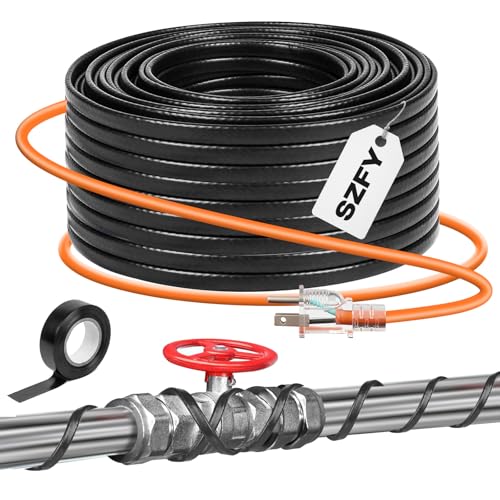
SZFY offers a wide range of lengths (3 ft to 207 ft), appealing to both small projects and long runs along roofs, gutters, or exposed drainage lines. The design emphasizes high heating efficiency with a 12W/ft core, backed by a copper center for uniform heat distribution. The 18-foot cord includes an indicator light, simplifying monitoring. Outer layers combine aluminum shielding and a durable, high/low-temperature-resistant TPE jacket. The 120V system is designed for robust outdoor use, and the manufacturer notes UL and other standards compliance, aiming to support energy-efficient, durable outdoor heating for wastewater and drainage scenarios.
Buying Guide: Key Considerations For Selecting Sewer Pipe Heat Tape
- Length and layout: Measure the pipe run to determine whether you need a short, mid, or long heat tape. Panels that can be traced straight, spiraled, or overlapped offer installation flexibility for irregular routes.
- Electrical safety and certifications: Look for products with full-cable certifications (ETL, CSA, UL). Ensure the plug is UL-listed and that the entire cable is certified to minimize risk of shock or fire.
- Pipe material compatibility: Most heat tapes work with both metal and plastic pipes (copper, PVC, PEX). Verify compatibility with your pipe material to avoid overheating or ineffective heating.
- Temperature range and output: Consider the minimum ambient temperature in your area. Heaters commonly operate in the -40°F to -112°F range; select wattage (e.g., 3 W/ft, 5 W/ft) that suits your climate and energy goals.
- Durability and environment: Outdoor installations require weatherproof jackets (TPE, fluoropolymers) and moisture protection (IP ratings). For coastal or high-salinity settings, corrosion-resistant cores and shielding are beneficial.
- Installation ease: Pre-assembled cables with built-in thermostats simplify setup. Some models include indicator lights and pre-attached power cords for quick deployment.
- Maintenance and warranty: Consider products with extended warranties and long service life. Some brands offer liability coverage as part of the purchase for added protection.
- Safety integration: Ensure compatibility with your electrical panel and outlet availability. Use a dedicated circuit or GFCI outlet where required by local codes.