Best Laminar Flow Hoods for Mycology and Mushroom Cultivation
When cultivating mushrooms or performing sterile mycology work, a reliable laminar flow hood helps maintain a clean workspace by delivering a unidirectional stream of filtered air. This article highlights five top options, covering standalone laminar flow benches, horizontal and vertical units, and still-air alternatives. Each selection is evaluated for airflow stability, filter quality, build durability, and ease of use in real-world mycology tasks such as inoculation, transfer, and culture handling.
| Product | Brand | Key Feature | Category |
|---|---|---|---|
| Laminar Flow Hood With H13 HEPA | Shroomagic | H13 HEPA, 0.35–0.5 m/s airflow, 249 CFM | Stand-Alone Hood |
| Bonsai 12″x12″ 99.99% HEPA Horizontal Hood | Myco Labs | Horizontal flow, replaceable 99.99% HEPA filter | Horizontal Horizontal Hood |
| Bella Bora Still Air Box | Bella Bora | Still air, clear visibility, durable design | Still Air Box |
| YJINGRUI Laminar Flow Hood | YJINGRUI | H-14 HEPA, ISO 5, adjustable speeds | Laminar Flow Hood |
| HEPA H14 Filtration Laminar Flow Hood | TONGTONGFA | HEPA H14, 100/ISO 5 cleanliness, robust frame | Laminar Flow Hood |
Laminar Flow Hood With H13 HEPA Filter

The Laminar Flow Hood with H13 HEPA Filter by Shroomagic provides a spacious 20 × 15 inch work area with an overall footprint of 20 × 16.8 × 7.9 inches. It delivers a controlled laminar flow at 0.35–0.5 m/s and a maximum airflow of 249 CFM, supporting stable sterile conditions during inoculation, agar transfers, and other mycology tasks. The unit uses an H13-grade HEPA filter capable of removing 99.95% of particles as small as 0.3 microns, offering strong protection for tissue culture and mushroom cultivation environments. Dual DC brushless fans support consistent air delivery, while an integrated LED light assists visibility during delicate procedures. A 24V DC system with a 100–240V adapter ensures compatibility with various setups. This model is well-suited for hobbyist studios and more demanding cleanroom applications where space efficiency matters.
Key points to consider: sealing integrity around the work surface, ease of filter replacement, and the balance between airflow speed and noise. While this unit emphasizes a compact footprint, the combination of a high-quality HEPA filter and dual fans makes it a solid choice for reliable laminar flow in mycology workflows.
Bonsai 12″x12″ Laminar Flow Hood For Mushrooms

The Bonsai 12″x12″ HEPA Horizontal Laminar Flow Hood from Myco Labs offers a compact, portable solution designed specifically for mushrooms and mycology. It features a replaceable 99.99% HEPA filter intended to last a year or longer, with construction that emphasizes durability and USA-made craftsmanship. The horizontal airflow orientation is ideal for direct work at the front of the hood, supporting precise inoculation and transfers with minimal turbulence near the sample area. This unit is particularly appealing for researchers and hobbyists who need a reliable, space-efficient bench that can be moved between workstations.
Considerations for users include filter replacement scheduling, blade alignment for uniform flow across the work surface, and the availability of replacement parts in case of wear. The Bonsai hood aims to balance portability with dependable performance, making it suitable for those who operate in smaller labs or personal spaces where traditional large benchtop models are impractical.
Bella Bora Still Air Box For Mycology
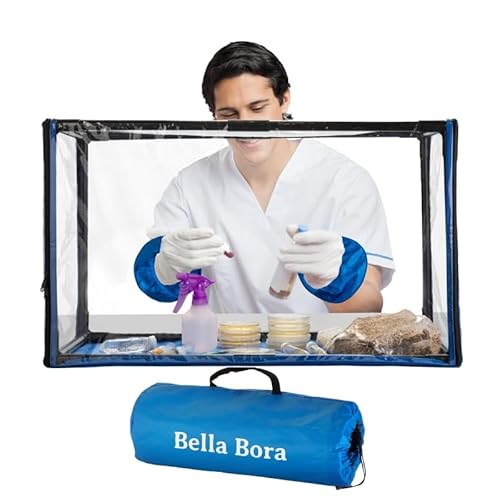
Bella Bora’s Still Air Box is designed as a sturdy alternative to traditional laminar flow hoods. It emphasizes enhanced visibility, durability, and ease of setup, with features that improve arm flexibility and overall usability in mycology procedures. The design supports a clear working space, reducing the risk of accidents during inoculations and transfers. The product emphasizes longevity with a scratch-resistant and waterproof exterior, making it suitable for frequent use in lab settings. While not a true laminar flow cabinet, this still-air solution can be effective for certain practice scenarios where unidirectional airflow is less critical or when rapid setup and breakdown are necessary.
Users should consider the trade-off between still air and laminar flow when selecting equipment for sterile tasks. For beginners or those prioritizing price and simplicity, this option can provide a practical, reliable workspace, though it does not guarantee the same level of particulate control as a certified laminar flow hood.
YJINGRUI Laminar Flow Hood

The YJINGRUI Laminar Flow Hood features an H-14 HEPA filter with Class 100/ISO 5 cleanliness, making it suitable for high-sensitivity mycology work and laboratory applications. The unit includes a safety-lock design and three adjustable airflow speeds, offering a balance between strong filtration and controlled air movement. The 22.6 x 22.6 inch footprint provides a larger working area than many compact hoods, supporting larger inoculation tasks or transfers. Operating at 110V, it suits standard lab power setups, and the unit’s build emphasizes stable performance and durability under routine use.
Key considerations include the total air volume and velocity range, filter replacement accessibility, and ease of calibration. For laboratories or serious hobby setups that require strong ISO 5 conditions, the YJINGRUI hood provides a robust option with flexible airflow management and a larger work surface than some smaller models.
HEPA H14 Laminar Flow Hood With FFU

The HEPA H14 Filtration Laminar Flow Hood from TONGTONGFA includes a complete FFU (Fan Filter Unit) setup, delivering HEPA H14 filtration and ISO 5 cleanliness. The galvanized frame, aluminum fan blades, copper motor, and reinforced metal casing emphasize durability for laboratory and mushroom cultivation environments. Three-speed airflow control and a typical 22.6” x 22.6” footprint provide a broad work surface with adjustable laminar flow. This model is designed for those who prioritize industrial-grade filtration efficiency and long-term reliability in demanding clean room or mycology workflows.
Important factors include the FFU’s maintenance cycle, ease of access for filter replacement, and the total cost of ownership given its heavier construction. The H14 filtration level offers excellent protection for sensitive cultures and experiments requiring stringent particle control, particularly in professional or research-grade setups.
Yzzwer Laminar Flow Hood FFU

The Yzzwer Laminar Flow Hood with FFU provides a modern take on laminar flow, offering an updated generation of fan filtration units. The unit uses an H13 HEPA filter and promises 99.99% filtration efficiency for particles around 0.3 microns, aligning with ISO 5 cleanliness. A three-position push-button control adjusts airflow, with average speeds around 0.45–0.60 m/s and an airflow capacity up to 800 m³/h. This configuration supports effective removal of airborne contaminants during inoculation and other delicate lab tasks, while maintaining a manageable footprint for mid-sized workspaces.
Pros include improved suction and discharge of particles, straightforward operation, and a modern design that balances performance with user-friendly controls. Potential drawbacks are variations in airflow across the filter surface in some setups and the need for periodic FFU maintenance to keep performance consistent over time.
MSFULLSEA Laminar Flow Hood

The MSFULLSEA Laminar Flow Hood is described as a HEPA-filtered unit designed for both hobbyist and DIY applications, delivering a directional airflow rather than guaranteed full laminar flow. It features a three-layer filtration system that includes a HEPA filter rated at 99.95% filtration, with a composition of fiber filters and a detachable HEPA stage. While not certified to deliver ISO 5 air everywhere, it can create a clean workspace for basic mycology and tissue culture tasks when used within its designed limitations. The product notes emphasize portability and ease of use for smaller projects, including phone, LCD, or simple laboratory setups.
Best use cases include beginner projects or secondary clean areas where a full ISO 5 environment is not strictly required. For rigorous sterile work, consider models that explicitly advertise ISO Class 5 or Class 100 compliance and certified laminar flow performance.
Vertical Laminar Flow Hood By Yzzwer

The Vertical Laminar Flow Hood from Yzzwer features a tall, vertical laminar hood with a corresponding fan-filter unit designed for Class 100/ISO 5 cleanliness in mycology and clean room environments. The unit measures 23.6″ x 23.6″ and 29″ in height, offering substantial working space and ease of access from above. It uses a three-position push-button control to adjust the average air velocity between 0.45 and 0.60 m/s and can achieve an airflow of up to 800 m³/h. The aluminum construction ensures durability and lightweight handling, making installation and maintenance straightforward in a larger lab setting.
Considerations for vertical layouts include space requirements, ease of mounting, and the need to ensure adequate clearance for operator movement around the unit. This model is well-suited for larger mushroom cultivation setups or labs that require a prominent, tall hood to accommodate bigger projects and gloves-free handling of specimens.
Buying Guide: Key Purchase Considerations
- Filtration level and classification: If your work demands stringent sterility (ISO 5/Class 100), prioritize hoods with H13 or H14 HEPA filters and explicit ISO/Class 5 ratings.
- Airflow type and stability: Laminar flow hoods provide a steady, unidirectional stream, while still-air boxes offer basic protection. Consider whether you need true laminar flow for inoculations or a simpler setup for routine transfers.
- Work surface and footprint: Larger work areas support more complex procedures but require more space. Match the hood size to your typical tasks and available bench space.
- Power and compatibility: Check voltage compatibility (110V vs 220V) and whether a multi-voltage adapter is included or required for your lab environment.
- Maintenance and parts availability: Easy access to HEPA filter replacements, FFUs, and spare parts can extend the life of the hood and reduce downtime.
- Durability and materials: Look for galvanized frames, aluminum components, and robust casings that withstand frequent use in a lab setting.
- Noise and energy use: Higher airflow often means more noise and energy consumption; balance performance with a comfortable working environment.
- Mobility and installation: Portable units are convenient for small spaces or temporary setups, while fixed installations may be preferred in dedicated labs.
When selecting among these options, assess your strictness of sterile requirements, space constraints, and whether you prioritize portability, ease of maintenance, or maximum filtration efficiency. For serious mycology work in a dedicated space, prioritize models with ISO 5/Class 100 certification and a robust FFU or HEPA filtration system. For hobbyist setups or secondary clean spaces, a well-built still-air box or a smaller horizontal hood may be sufficient and more budget-friendly. Always follow manufacturer guidance for installation, operation, and replacement intervals to maintain optimal performance over time.