Best Pool Heat Exchangers for Boiler Systems
Pool heat exchangers can help conserve energy by transferring heat from a boiler or solar system to your pool water, spa, or hot tub. This guide highlights five reliable options, detailing capacity, material quality, and compatibility to help American homeowners choose a unit that fits their heating source and pool size. The selections emphasize corrosion resistance, efficient heat transfer, and durable construction for long-term performance.
| Product | Capacity | Material | Ports | Warranty |
|---|---|---|---|---|
| AB 300 kBTU Heat Exchanger | Up to 23,800 gallons | 316L Stainless Steel | 2″ & 1 1/2″ FPT | 1 year |
| AB Pool Heat Exchanger 300 kBtu | Up to 23,800 gallons | 316L Stainless Steel | 2″ & 1 1/2″ FPT | 1 year |
| Jiabailie 200KBTU Pool Exchanger | Noted 200 kBtu/hr freshwater transfer | 304 Stainless Steel | 1″ & 1 1/2″ FPT | Not specified |
AB 300 kBTU Heat Exchanger For Outdoor Wood Boiler Or Pool

The AB 300 kBTU unit is designed for outdoor wood boiler applications, with corrosion-resistant stainless steel 316L suitable for pools, spas, and chlorinated water. It features opposite ports at 2″ and 1 1/2″ FPT and offers a practical capacity for mid-sized to large pools. A one-year warranty provides basic assurance of durability and performance in typical pool environments.
AB Pool Heat Exchanger 300 kBtu Stainless Steel

This AB model uses stainless steel 316L to withstand chemical-treated pool water while delivering up to 300 kBtu/hr heat transfer. It is designed for 23,800-gallon pools and features corrosion-tolerant construction with a one-year warranty. Its same-side port configuration simplifies installation in limited spaces and aligns well with standard pool heating setups.
Jiabailie 200KBTU Pool Exchanger

Constructed from 304 stainless steel, the Jiabailie exchanger emphasizes durability and reliable heat transfer for pools, hot tubs, and solar-assisted heating. It supports 1″ and 1 1/2″ FPT connections and is designed to maintain consistent temperature by transferring heat between hot water circuits and pool water. The design aims for rapid heating while preserving water quality in treated environments.
DEIGEHJRE Pool Heat Exchanger Tube
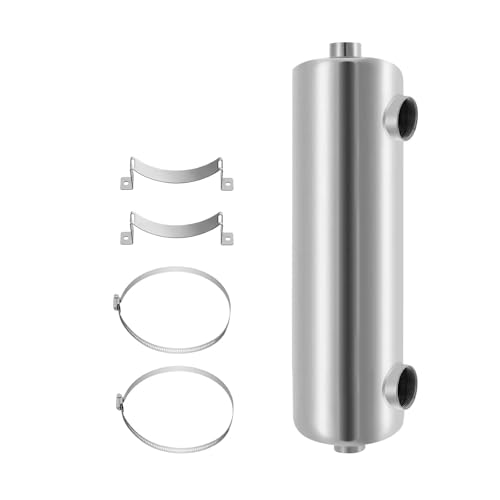
The DEIGEHJRE exchanger uses 304 stainless steel for durability and stable performance in pool and spa environments. It provides 200 kBtu/hr of freshwater heating capacity, with a design oriented toward consistent temperature maintenance and compatibility with various heating sources, including boilers and heat pumps. Its fast heating profile minimizes wait times for pool readiness.
KinHall Pool Heat Exchanger 200kBtu

The KinHall exchanger emphasizes reliability and efficiency with 304 stainless steel construction and titanium-enhanced design elements in some models. It is compatible with boiler, heat pump, geothermal, or solar heating systems and uses straight tubes to reduce pressure loss, supporting steady heat transfer for spa and pool applications. Port sizing includes 1 1/2″ FPT connections for flexible installation.
Buying Guide: How To Choose The Right Pool Heat Exchanger For Your Boiler System
Important factors influence the effectiveness and lifespan of a pool heat exchanger in boiler-based heating setups. The following perspectives help cover practical considerations, safety, and long-term value.
- Pool size and heater load: Larger pools require higher heat transfer capacity. Select a model with enough BTU/hr to match the temperature rise you want compared to the boiler water, while avoiding excessive load that could overtax your heating system.
- Water chemistry and corrosion resistance: Pools often contain chlorine or salt systems. Stainless steel 316L is highly resistant to corrosion in chlorinated water, while 304 stainless steel offers solid durability at a lower cost. Titanium-based units deliver superior longevity in aggressive water chemistries but at a higher price.
- Port configuration and installation: Consider port sizes (2″ and 1 1/2″ FPT, etc.) and port alignment. Same-side versus opposite-port arrangements affect ease of installation in tight spaces and compatibility with existing piping.
- Heat source compatibility: Ensure the exchanger works well with your boiler, heat pump, solar preheater, or geothermal loop. Some units are optimized for outdoor wood boilers, while others are better suited for solar-assisted systems.
- Temperature rise and heat transfer rate: Look for a defined BTU/hr rating and typical operating conditions (temperature difference between incoming heating water and pool water). This helps estimate how quickly your pool will reach target temperatures.
- Maintenance and warranty: A 1-year warranty is common, but check for corrosion resistance, cleaning access, and ease of service. Consider whether the unit allows for easy scale removal or cleaning if your water is hard or mineral-rich.
- Economics and lifecycle cost: Titanium options offer exceptional longevity but may have higher upfront costs. Stainless 316L is a balanced choice for general poolwater applications with chlorine or mild saltwater exposure.
- Safety and installation standards: Ensure proper codes and clearances for outdoor installations, electrical safety when integrating with boilers, and professional installation recommendations to avoid leaks or pressure issues.
When evaluating options, align the chosen exchanger with the boiler’s heat source capacity, pool volume, and your maintenance preferences. For homeowners seeking durability and broad compatibility with treated water, 316L stainless steel models provide reliable performance at a moderate price point. If the water chemistry is highly corrosive or if lifetime cost is a priority, titanium-based models offer superior longevity. Always consult a qualified installer to verify that the selected exchanger matches your system’s pressure ratings and safety requirements.