Power roof vents help remove hot air and moisture buildup in attic spaces, supporting energy efficiency and longer roof life. This guide highlights five top options, showcasing airflow capacity, installation ease, and smart or manual control features. Each product is evaluated on performance, durability, and value for American homes.
Summary Table of Selected Products
| Product | Brand | Airflow (CFM) | Coverage (sq ft) | Key Features |
|---|---|---|---|---|
| Master Flow ERV6BL Gable Attic Fan | Master Flow | 1500 | Up to 2800 | |
| Master Flow PT6 Power Roof Vent | Master Flow | 1000 | Up to 1600 | |
| Master Flow 1250 CFM Wi‑Fi Vent | Master Flow | 1250 | Up to 2200 | Smart Wi‑Fi control, app, humidistat/thermostat |
| iLiving Hybrid Solar Roof Attic Fan | iLiving | 1150 | Up to 2900 | Smart thermostat, solar panel adjustability, IP68 motor |
| Cool Attic CX1500 Gable Vent | Cool Attic | 1500 | Up to 1850 | Thermostat-controlled, quiet operation |
Note: All products listed are designed to vent attics through the roof or gable mounts, helping to reduce heat buildup and moisture while supporting cooling efficiency in residential settings.
Master Flow ERV6BL 1500 CFM Roof Mount Attic Fan

The Master Flow ERV6BL is a powerful roof-mount attic fan designed to move up to 1,500 CFM, cooling attics up to 2,800 square feet. It features a built-in HT1 thermostat/humidistat for responsive cooling and a durable galvanized steel housing with a built-in screen to deter pests. This unit emphasizes energy efficiency through effective ventilation and temperature-aware operation, helping reduce attic heat transfer to living spaces.
Master Flow PT6 Power Roof Vent

The PT6 model from Master Flow delivers robust exhaust with efficient operation. It is engineered for easy installation and is built with galvanized steel for durability. The included thermostat helps regulate attic temperatures, supporting energy savings by reducing conditioned air loss and minimizing heat buildup that can affect roof integrity.
Master Flow 1250 CFM Wi‑Fi Attic Vent

This 1,250 CFM unit combines strong airflow with modern smart control. QuickConnect Wi‑Fi enables remote operation via a mobile app, while the humidistat and thermostat settings can be monitored and adjusted from anywhere. It covers up to about 2,200 square feet, supporting efficient moisture management and heat removal in larger attic spaces.
iLiving HYBRID 1150 CFM Solar Roof Attic Fan

The iLiving hybrid unit integrates solar power with an intelligent thermostat system. It includes a 14″ blade, 1,150 CFM capability, and adjustable solar panel angles for optimizing solar input. Coverage can reach up to 2,900 square feet, making it suitable for larger or sun-exposed attic spaces where electrical access is limited or where solar savings are prioritized.
Cool Attic CX1500 Gable Mount Attic Fan
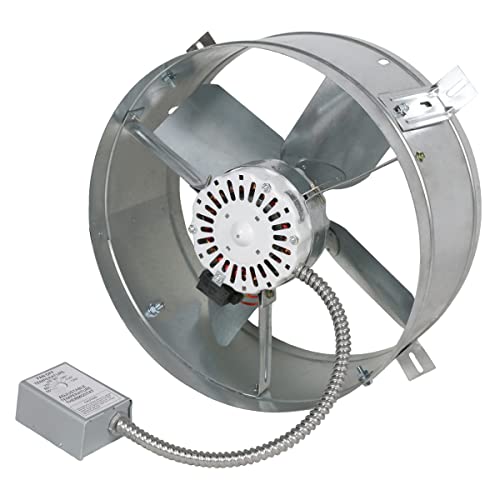
The CX1500 from Cool Attic provides 1,500 CFM airflow in a compact 14-inch gable-mount design. It emphasizes thermostat-controlled operation for automatic cooling, helping to maintain attic temperatures within set ranges and improving overall energy efficiency. The unit focuses on quiet operation to minimize household disruption while delivering strong ventilation.
Buying Guide
When selecting a power vent for a roof, consider how the unit will integrate with your existing attic and home cooling strategy. Key purchase considerations include:
- Airflow and Area Coverage: Match CFM to attic size. Larger attics may require 1,200–1,500 CFM or more, especially in hot climates.
- Thermostat and Humidity Control: Thermostats or humidistats help automate ventilation, saving energy by running only when necessary.
- Power Source and Wiring: Plug-in units are easier to install but may require a nearby outlet, while hardwired models provide permanent solutions with professional installation.
- Durability and Materials: Galvanized steel housings resist corrosion and foster long life in harsh attic environments.
- Noise Levels: Look for models designed for quiet operation, particularly in living spaces adjacent to the attic.
- Smart Features: Wi‑Fi control and mobile apps enable remote monitoring, scheduling, and optimization of ventilation patterns.
- Electrical Load and Safety: Ensure compatibility with home electrical circuits and check for ETL or UL listings where applicable.
- Installation Conditions: Roof mount vs. gable mount depends on attic layout and roof design; ensure proper sealing to prevent leaks.
Performance perspectives differ by climate and home design. In hot, sunny regions, higher CFM with automatic thermostats can prevent attic heat buildup and reduce cooling loads. In milder climates, simpler, cost-effective venting might suffice. Some homes benefit from a combination of intake and exhaust ventilation to promote balanced airflow. In all cases, coordinating attic ventilation with ceiling insulation, ductwork, and HVAC efficiency yields the best results.