Geothermal heating and cooling rely on precise thermostat control to maximize efficiency and comfort. The right smart thermostat can optimize minute-by-minute energy use, manage multiple stages, and work with your geothermal heat pump. In this guide, five compatible options are examined for homes with geothermal setups, focusing on energy savings, installation ease, and compatibility with 24V HVAC systems.
| Product | Brand | Compatibility | Highlights |
|---|---|---|---|
| Google Nest Thermostat | Most 24V systems; works without C wire in many homes | Energy savings; easy app control | |
| ecobee Smart Thermostat Enhanced | ecobee | 24V systems; supports multiple sensors | Works with Siri, Alexa, Google Assistant; Energy Star |
| Cielo Smart Thermostat Eco | Cielo Breez | Conventional up to 2H/2C; heat pumps up to 4H/2C; not for minisplits | Free C-Wire adapter; Energy Star |
| Sensi Smart Thermostat | Emerson | Most HVAC equipment; common wire not required | Privacy protection; DIY friendly |
| Honeywell Home RTH6580WF | Honeywell Home | Wi‑Fi 7‑Day programmable; supports voice assistants | Easy app control; DIY installation |
These options balance geothermal compatibility with modern features like remote control, scheduling, and adaptive comfort. Each model supports common wire configurations and offers energy reporting to help you quantify savings over time. The following sections review five products in depth, with a focus on how they fit a geothermal system in typical American homes.
Google Nest Thermostat For Geothermal Homes
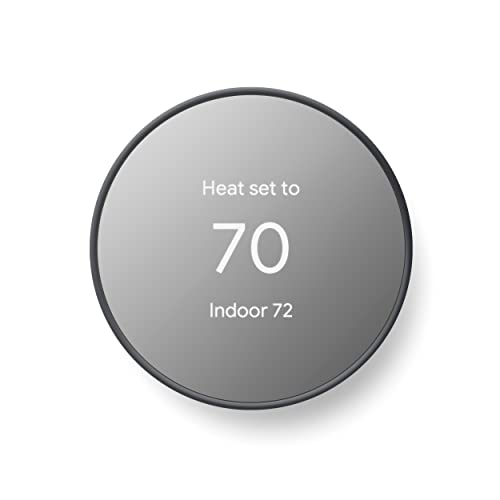
The Nest Thermostat is ENERGY STAR certified and designed to save energy in homes with heating and cooling demand. It connects via Wi‑Fi (2.4 GHz and 5 GHz) and supports Bluetooth Low Energy for easy setup and extension. A key note is its compatibility with systems that often don’t require a C wire, though some configurations—such as heat pumps or zone-controlled setups—may benefit from a dedicated power accessory. Nest automatically reduces power use when homes are unoccupied, helping to cut energy waste without sacrificing comfort. Lock features are not included.
For geothermal systems, the Nest’s scheduling and sensor integration can help maintain consistent temperatures without cycling the geothermal heat pump excessively. The Nest Compatibility Checker can verify suitability for your specific geothermal configuration before purchase. While it provides robust wireless control, some users may prefer a thermostat with more built-in sensing or multi-stage support, depending on the complexity of their loop field and pump strategy.
ecobee Smart Thermostat Enhanced
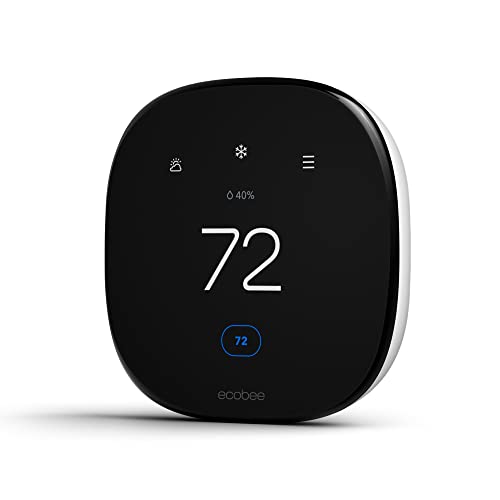
ecobee’s Smart Thermostat Enhanced is a feature-rich option for geothermal systems, offering native Alexa, Google Assistant, and Siri compatibility. It includes remote access, weather-responsive controls, and the ability to use additional room sensors to balance temperature where people spend time. The thermostat is ENERGY STAR certified and supports automatic away/home adjustments to minimize HVAC usage when the home is unoccupied. It integrates well with multi-zone or multi-room configurations common in larger geothermal installs, helping to maintain even temperatures without overworking the system.
Installation is designed to be DIY-friendly, though some setups may require professional assistance if multiple circuits or sensors are involved. The device optimizes comfort by predicting occupancy patterns and adjusting settings accordingly, which can be beneficial for geothermal systems that cycle on/off based on outdoor temperatures or humidity. It does not rely strictly on complex wire configurations, making it a solid choice for many households seeking smarter energy management through a single, familiar interface.
Cielo Smart Thermostat Eco

The Cielo Smart Thermostat Eco emphasizes energy savings and broad compatibility with 24V HVAC systems, including many geothermal configurations. It supports up to two heating and cooling stages for conventional systems and up to four stages for heat pumps, with a dedicated C-wire adapter included in the box. ENERGY STAR certified, this model aims to reduce energy bills while offering reliable DIY installation. It lists compatibility with 2H/2C conventional and heat pump setups, while clearly noting not for mini-split systems, which are common in some geothermal layouts that rely on zone controls or supplemental heat sources.
For geothermal users, the Cielo Eco can be a good match when a C-wire is absent or unreliable. The included adapter helps power the thermostat without adding a separate power accessory. The interface supports typical scheduling and control features, enabling you to tailor heating and cooling cycles to the thermal mass of a geothermal loop. If your system uses more advanced controls or zone dampers, verify the exact stage support and compatibility with your heat pump configuration before purchase.
Sensi Smart Thermostat ST55
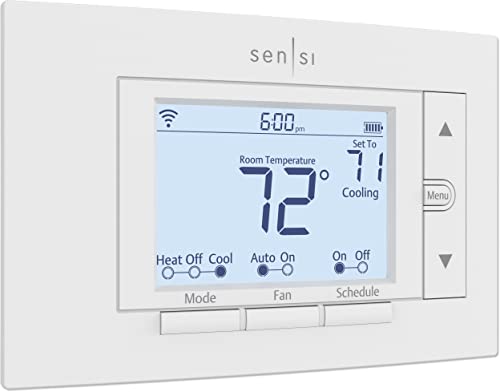
The Sensi thermostat emphasizes privacy, DIY friendliness, and straightforward operation. It is ENERGY STAR certified and supports remote access through a mobile app with flexible scheduling and usage reporting. A key advantage is that many installations do not require a C-wire, which can simplify setup for homes with older electrical configurations common in geothermal retrofits. Sensi is designed to work with a wide range of HVAC equipment and is often recommended for installations where simple, reliable operation matters more than advanced multi-zone capabilities.
In geothermal contexts, Sensi provides dependable temperature control for single-zone or smaller multi-zone loops. The app-centric experience makes it easy to monitor energy usage and adjust schedules while the privacy-focused stance ensures minimal data sharing. If your home uses multiple zones or a more complex heat pump arrangement, pairing Sensi with a zoning controller may be necessary to maintain even comfort across spaces.
Honeywell Home RTH6580WF Wi‑Fi 7‑Day Thermostat

The Honeywell RTH6580WF offers a seven-day programmable schedule and strong Wi‑Fi connectivity, with compatibility for voice assistants and smart home ecosystems. The user experience centers on straightforward programming and reliable remote control. This model is suitable for geothermal systems that benefit from a consistent, scheduled heat pump operation and predictable setback/restore patterns. It is generally accessible for DIY installation and integrates well with standard 24V HVAC configurations, including systems that may require a dedicated C-wire for continuous power.
For geothermal setups, the RTH6580WF provides a practical balance of features, ease of use, and compatibility. It supports multiple daily schedules and can respond to weather changes with adaptive programming to reduce energy use. While it lacks some of the sensor-based comfort features found in high-end models, it remains a dependable choice for steady, cost-conscious geothermal operation.
Buying Guide: Key Purchase Considerations For Geothermal Systems
- System compatibility: Verify that the thermostat supports 24V HVAC and, if needed, a C wire or compatible power accessory. Geothermal heat pumps vary in stages and control requirements, so ensure the thermostat can handle the number of heat/cool stages and any zone controllers you use.
- Energy efficiency features: Look for ENERGY STAR certification and adaptive scheduling, occupancy-based controls, and remote access to maximize savings on geothermal energy use.
- Smart home integration: If you use voice assistants or home automation, prioritize models with broad compatibility (Alexa, Google Assistant, Siri) and reliable mobile apps to manage settings remotely.
- Wiring and installation: Some models are more DIY-friendly, while others may require professional installation for complex zoned or multi-stage systems. A C-wire adapter can simplify wiring in homes without a direct C wire.
- Sensor support and zoning: If you have multiple zones, consider a thermostat that works with additional room sensors or integrates with a zoning system to maintain even temperatures across spaces.
- Reliability and data privacy: Review privacy policies and data usage. A model that prioritizes user data protection can be important for households sensitive to data sharing.
- Future-proofing: Choose a model with ongoing software updates and easy compatibility with evolving smart home ecosystems to extend the thermostat’s useful life in a geothermal setup.
When selecting a thermostat for geothermal systems, the goal is balancing reliable control with energy savings. Each option reviewed offers distinct advantages—from sensor-driven comfort to straightforward programming. Assess your home’s wiring, zoning, and preferred level of smart features to identify the best fit for your geothermal installation.