Choosing the right thermostat for a heat lamp helps maintain safe, stable temperatures for reptiles, seed starting, greenhouses, and incubation setups. This guide highlights reliable digital controllers designed to regulate heat lamps and mats, with quick setup, precise sensors, and safety features. Read on to compare five strong options and learn what to look for when shopping.
| Product | Brand | Key Benefit |
|---|---|---|
| BN-LINK Reptile Thermostat | BN-LINK | Simple setup, clear display, durable |
| WILLHI WH2408 Temperature Controller | WILLHI | Versatile, broad range, memory on outage |
| Inkbird ITC-308 Digital Controller | Inkbird | Dual relay, easy display |
| REPTIZOO Dimming Thermostat | REPTI ZOO | PID dimming for stable heating |
| HEATIT ET-21 | HEATIT | Auto on/off with ambient sensing |
Below are five products commonly used with heat lamps, reptile enclosures, incubators, and seedling start-ups. Each section includes a brief overview, main features, and how it supports stable, safe heating environments.
BN-LINK Reptile Thermostat Controller

The BN-LINK reptile thermostat controller is designed for heating devices such as reptile heat mats, seedling heat mats, and heat lamps. It supports a broad temperature range from 40°F to 108°F, and it includes both a temperature sensor probe and a 3.94 ft power cord plus a 4.92 ft probe for flexible placement. The device is intended for heating rather than cooling and offers an easy three-button interface to switch between Fahrenheit and Celsius. A bright display and indicator lights aid visibility in dark enclosures or rooms.
Reference features:
- Effortless setup with 3-button control; Fahrenheit/Celsius toggle.
- User-friendly LED indicators for heating and power status.
- Rugged construction with a dedicated sensor probe and long cords for flexible placement.
Best use cases include reptile tanks, seedling mats, incubators, and greenhouse heat mats where a simple, reliable controller is preferred. The device’s simplicity can be an advantage for beginners or setups prioritizing straightforward operation over advanced programming.
WILLHI WH2408 Temperature Controller

The WILLHI WH2408 provides a 10A, 1200W digital thermostat outlet switch for controlling heat lamps, incubators, greenhouses, and other heating devices. It features two knobs for on/off temperature adjustments, enabling intuitive setup without complex menus. It can operate in heating or cooling mode, supports memory of settings during power outages, and covers a wide ambient range from -4°F to 140°F. The product is designed to minimize disruption, save energy, and reduce setup time, with a robust, fire-retardant ABS shell for safety.
Reference features:
- Two-knob adjustment for quick, precise temperature control.
- Memory feature preserves settings after power loss.
- Rugged design with safety-focused ABS housing; broad application range.
Ideal for reptile tanks, terrarium heat lamps, greenhouses, and even some culinary applications like fermentation and sous vide when a controlled environment is needed. Its flexible use makes it a popular choice when users want more than a single-purpose thermostat.
Inkbird ITC-308 Digital Temperature Controller

The Inkbird ITC-308 is a two-stage outlet thermostat suitable for heating and cooling operations. It supports °C/°F displays and dual relays, enabling simultaneous control of heating and cooling devices as environmental conditions change. The dual display window allows monitoring of both measured temperature and set temperature at the same time. This makes it a versatile option for greenhouses, incubators, terrariums, and homebrew fermentation setups where precise temperature management is essential.
Reference features:
- Easy-to-read display in Celsius or Fahrenheit.
- Dual-relay capability for heating and cooling in one unit.
- Dual display window for convenient monitoring.
Usage scenarios include reptile enclosures requiring stable heat and humidity, seedling germination, and fermentation processes where maintaining steady temperatures is critical for outcomes and safety.
REPTIZOO Dimming Thermostat
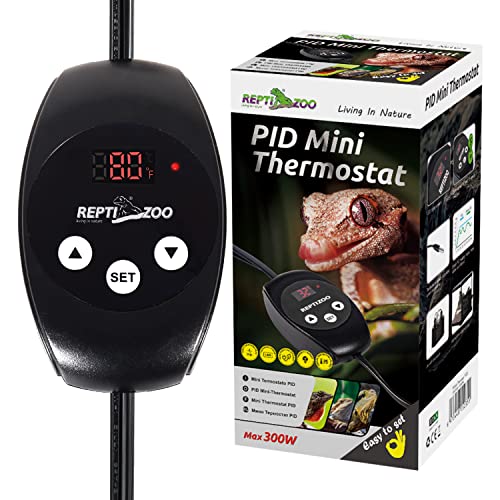
The REPTIZOO dimming thermostat focuses on precise dimming control for heat lamps and heaters. This PID-based controller aims to improve bulb lifetime by providing smooth, stable heating rather than abrupt on/off cycles. It’s suitable for heat lamps, bearded dragon lamps, gecko and lizard habitats, and other beasty enclosures, though it is not recommended for sunlamps. The device offers a memory function to preserve prior settings and a clear LED display showing ambient temperature and target setpoint.
Reference features:
- PID dimming mode for stable temperature with longer bulb life.
- Memory function preserves settings across power cycles.
- Easy setup with a user-friendly display and a sensitive probe.
Best used where gradual temperature changes are critical to the health and behavior of reptiles, or where consistent heat source output is needed for incubation or hatching environments.
HEATIT ET-21 Freeze Thermostatically Controlled Outlet

The HEATIT ET-21 is a thermostatically controlled outlet that turns on below 38°F and turns off near 50°F. It is designed to automate power to outlets in dry locations, with a maximum of 15 amps. The device features a smart indicator light that shows when the outlet is energized. It is well-suited for frost protection in brooders, incubators, and other cold-sensitive setups where ambient temperature needs to be maintained within a narrow band.
Reference features:
- Automatic on/off based on ambient temperature with clear indicator light.
- Simple installation by plugging into a standard outlet.
- CSA approved for dry-location use with up to 15 amps.
Applications include frost protection for seedling starts, reptile habitats in cooler environments, and other scenarios where a low-temperature limit is essential for safety and viability.
Buying Guide: Key Purchase Considerations For Heat Lamp Thermostats
When selecting a thermostat for heat lamps, consider these aspects to match the device to your setup:
- Temperature range and precision: Look for a controller that covers the temperature band you need and offers precise control, especially for sensitive reptile habitats or incubators. PID-based dimming controllers help maintain stable temperatures with fewer fluctuations.
- Relay type and cooling/heating modes: Dual-relay or two-stage controllers can handle heating and cooling cycles. For simple heat lamps, a single-stage device may suffice, but dual-stage designs offer flexibility for mixed environments.
- Sensor placement and response time: A probe positioned close to the heat source provides better readings for immediate adjustments. Flexible cords and probes help place sensors in the right spot without interfering with the setup.
- Ease of use and setup: Three-button interfaces or two-knob controls can simplify initial setup. A clear display and status indicators improve day-to-day operation, especially in dim or dark enclosures.
- Power handling and safety: Check maximum wattage and amperage ratings to ensure compatibility with your heat lamp or heater. ABS housings, fire-retardant design, and safety features reduce risk in enclosed spaces.
- Memory and power-outage behavior: Controllers that memorize settings help avoid reconfiguring after a power outage, saving time and ensuring consistent conditions.
- Application fit: Some devices are tailored for specific uses—reptile habitats, seed germination, incubators, or general greenhouse heating. Consider whether you need a specialized reptile dimmer or a general-purpose thermostat.
Comparison snapshot: For beginners prioritizing simplicity, a BN-LINK or Inkbird unit offers straightforward operation with reliable readings. For those needing precise, stable temperature management and memory features during outages, WILLHI or REPTIZOO provide more advanced control. HEATIT provides ambient-triggered automation, useful for frost protection, while Inkbird’s dual-relay approach suits setups requiring both heating and cooling controls.
Practical tips for deployment:
- Place sensors away from direct heat sources to avoid biased readings.
- Test the system with the heat source off to verify setpoints before enabling live operation.
- If using with multiple devices, consider a controller with adequate wattage headroom and safety features.
By evaluating temperature needs, enclosure design, and reliability requirements, you can select a thermostat that keeps heat lamps safe, efficient, and productive for your project.